
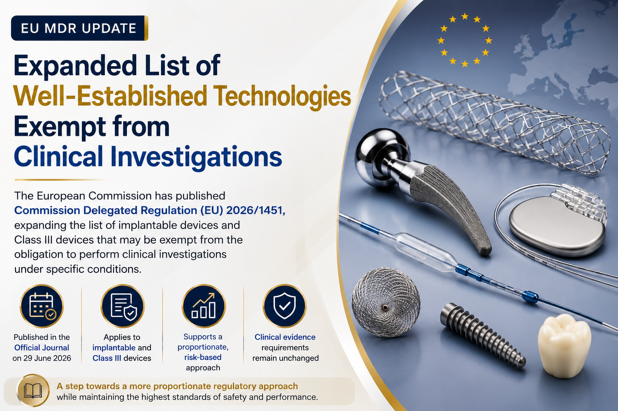
The European Commission has published Commission Delegated Regulation (EU) 2026/1451, amending Regulation (EU) 2017/745 (EU MDR) by expanding the list of implantable devices and Class III devices that may be exempt from the obligation to perform clinical investigations under specific conditions.
The Regulation was published in the Official Journal of the European Union on 29 June 2026 and will enter into force 20 days after publication.
The amendment follows a review of the implementation of the EU MDR and recognises that several additional medical devices can now be considered Well-Established Technologies (WET). These devices typically have a long history of clinical use, well-understood safety and performance characteristics, and designs that have remained largely unchanged over time.
Rather than lowering the evidentiary standards established by the MDR, the Regulation introduces a more proportionate approach for technologies where sufficient clinical evidence is already available. Manufacturers remain responsible for demonstrating that their devices are safe, perform as intended, and comply with the applicable requirements of the MDR.
Why was the list expanded?
Clinical investigations are a fundamental part of generating clinical evidence under the EU MDR, particularly for implantable devices and Class III devices. However, the Regulation has always recognised that not every device requires a new clinical investigation.
Article 61(6)(b) already provided an exemption for certain device types where sufficient clinical data were available and the applicable regulatory conditions were met. Following several years of MDR implementation, the European Commission reviewed whether additional technologies met the same criteria.
The review concluded that many devices have demonstrated:
- Common, simple and stable designs
- Well-established safety profiles
- Predictable clinical performance
- Limited technological evolution
- A long history of successful clinical use within the European Union
Based on these characteristics, the Commission expanded the list of devices that may qualify for the exemption.
The revised list was developed during 2025 by a dedicated Task Force within the Medical Device Coordination Group (MDCG), following a public call for evidence that allowed manufacturers, notified bodies and other stakeholders to provide input.
What has changed?
Commission Delegated Regulation (EU) 2026/1451 replaces Article 61(6)(b) of the MDR with an expanded list of eligible implantable devices and Class III devices.
In addition to the devices already covered under the MDR, the amended list now includes several well-established technologies, including:
- Cranial perforators and cranio-blades
- Catheter passers
- Port catheters
- Introducers and dilators
- Ventricular drains
- Feeding tubes
- Suture accessories
- Bone wax
- Bone fillers
- Bone substitutes
- Stem centralisers
- Diaphyseal obturators
- Orthopaedic nails and anchors
- Spinal posterior fixation systems
- Dental implants
- Orthodontic devices
- Dental veneers
- Reusable surgical instruments
- Guidewires
- Pressure wires
- Pacing wires and leads
- Endovascular embolisation coils
- Embolisation particles
- Shunts
- Internal defibrillation paddles
The complete list is provided in Commission Delegated Regulation (EU) 2026/1451.
What does the exemption actually mean?
One point that deserves particular attention is that this amendment does not remove the requirement to generate clinical evidence.
Instead, it removes the obligation to conduct a new clinical investigation for eligible devices where the conditions specified in Article 61(6)(b) are fulfilled.
Manufacturers must still demonstrate compliance with the clinical evaluation requirements of the MDR by:
- Preparing and maintaining a Clinical Evaluation Report (CER)
- Demonstrating sufficient clinical evidence to support safety and performance
- Complying with applicable Common Specifications (CS), where available
- Maintaining an appropriate post-market surveillance (PMS) system
- Conducting Post-Market Clinical Follow-up (PMCF), where required
In other words, the amendment changes the route by which clinical evidence may be demonstrated for eligible devices; it does not remove the obligation to establish that the device is safe and performs as intended.
Practical implications for manufacturers
For manufacturers of Well-Established Technologies, the amendment provides an opportunity to reassess their clinical evidence strategy.
Where adequate clinical data already exist, it may be possible to rely on existing evidence rather than planning and conducting a new clinical investigation. This has the potential to reduce both regulatory timelines and development costs.
However, manufacturers should not assume that inclusion on the revised list automatically guarantees acceptance of their clinical evidence.
Notified Bodies will continue to assess whether the available clinical data adequately support the intended purpose, safety and performance of the device. The quality, relevance and sufficiency of the evidence remain central to the conformity assessment process.
Manufacturers should therefore ensure that their clinical evaluation is supported by appropriate scientific literature, clinical experience, post-market surveillance data, complaint analysis, vigilance information and risk management documentation.
Actions manufacturers should consider
Manufacturers with products covered by the revised WET list may wish to:
- Confirm whether their devices fall within the amended Article 61(6)(b).
- Review existing Clinical Evaluation Reports to determine whether sufficient clinical evidence is available.
- Evaluate whether planned clinical investigations remain necessary.
- Update technical documentation where appropriate.
- Discuss the proposed regulatory strategy with their Notified Body before relying on the exemption.
- Continue strengthening post-market surveillance and post-market clinical follow-up activities to support ongoing compliance.
Conclusion
Commission Delegated Regulation (EU) 2026/1451 represents a practical refinement to the implementation of the EU Medical Devices Regulation.
By expanding the list of Well-Established Technologies, the European Commission has recognised that certain mature technologies with long-established safety and clinical performance may not require new clinical investigations in every case.
At the same time, the fundamental principles of the MDR remain unchanged. Manufacturers must continue to generate robust clinical evidence, maintain comprehensive clinical evaluations, and demonstrate compliance with the General Safety and Performance Requirements throughout the product lifecycle.
For manufacturers of implantable and Class III devices, this amendment provides an opportunity to review existing clinical evidence strategies and determine whether the revised provisions can support a more efficient approach to MDR compliance.
References
- Commission Delegated Regulation (EU) 2026/1451 of 20 March 2026 amending Regulation (EU) 2017/745 as regards the list of implantable devices and Class III devices exempted from the obligation to perform clinical investigations.
- Official Journal of the European Union, L Series, 29 June 2026