
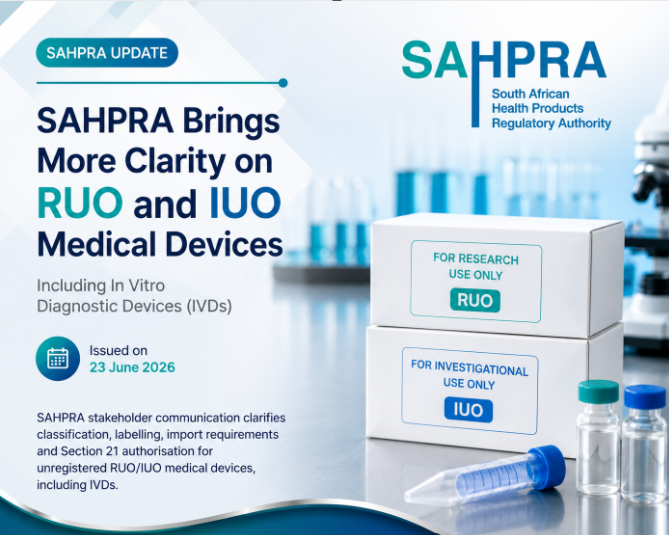
South African Health Products Regulatory Authority(SAHPRA) has published Communication to Stakeholders Issue No. MD01-2026/27, dated 23 June 2026,providing clarification on the regulatory requirements for Research Use Only (RUO) and Investigational Use Only (IUO) medical devices, including In Vitro Diagnostic (IVD) medical devices.
Manufacturers often use the terms Research Use Only (RUO) and Investigational Use Only (IUO) during product development. However, deciding when a device can be labelled RUO or IUO and when it falls under the requirements applicable to clinical use has not always been straightforward.
To address this, SAHPRA has issued this stakeholder communication explaining how RUO and IUO medical devices, including IVDs, should be classified, labelled, imported and regulated in South Africa.
Although the communication does not introduce a new regulation, it provides valuable clarification that manufacturers, importers, distributors, research institutions and laboratories should be aware of.
RUO Does Not Mean “Not Regulated”
A common misunderstanding is that a product labelled Research Use Only (RUO) falls outside the scope of regulatory oversight. SAHPRA makes it clear that RUO labelling has a specific purpose.
RUO devices are intended for laboratory research or other non-clinical research activities. They may include prototype devices, research reagents, software, instruments or components that are still being developed or evaluated. These products are not intended to generate results for clinical diagnosis or patient management.
Simply applying an RUO label does not permit a product to be used in routine clinical practice.
How IUO Is Different
Investigational Use Only (IUO) devices serve a different purpose.
These products are supplied for evaluation before commercial marketing. They may be used in performance evaluation studies, comparison studies or other investigations designed to establish how the device performs under defined conditions.
While IUO devices may be used as part of an investigation, they are not intended for routine clinical use until the applicable regulatory requirements have been fulfilled.
Labelling Should Match the Intended Purpose
One of the strongest messages in the communication is that the product label should accurately reflect how the device will actually be used.
If a device is intended for clinical diagnosis or patient management, it should not be labelled RUO or IUO simply because it has not yet completed registration.
SAHPRA also states that products incorrectly labelled as RUO or IUO may be regarded as misbranded, as such labelling could be considered false or misleading.
For manufacturers, this means that product labels, Instructions for Use (IFU), promotional materials and regulatory documentation should consistently describe the intended purpose of the device.
Importing RUO and IUO Devices into South Africa
The communication also explains the process for importing unregistered RUO and IUO medical devices into South Africa.
Importers must hold the appropriate import licence and obtain Section 21 authorisation before importing these products.
Applications are expected to include supporting documentation such as:
- Evidence of regulatory approval or recognition, where applicable
- Product labels
- Instructions for Use (IFU) or User Manual
- Proof of payment of the applicable fees
Another practical point is that only products belonging to the same device group or family may be included within a single Section 21 application.
Review Timelines
SAHPRA has indicated a target review period of 15 working days for complete applications.
Where deficiencies are identified, applicants are expected to respond within two working days. The communication also states that only two review cycles will normally be permitted before an application may be rejected.
Submitting a complete application at the outset can therefore help avoid unnecessary delays.
Practical Considerations for Manufacturers
For companies developing medical devices or IVDs, this communication is a timely reminder to review product labelling and intended use before products are supplied for research or evaluation.
Some practical questions worth asking include:
- Is the product genuinely intended only for research?
- Does the product generate results that may influence clinical decisions?
- Is Section 21 authorisation required before importation?
- Do the product label, IFU, promotional materials and technical documentation consistently describe the intended purpose?
Addressing these questions early in the development process can help prevent regulatory issues later.
Why This Matters
This communication reinforces an important regulatory principle, the intended use of a medical device determines the applicable regulatory pathway, not simply the wording printed on the product label.
Manufacturers involved in research, product evaluation or early-stage commercialisation should take this opportunity to review their labelling strategy and ensure that product claims, Instructions for Use and technical documentation remain aligned with the intended purpose.
Although many organisations already follow these principles, SAHPRA’s communication provides useful regulatory clarification and reinforces the authority’s expectations regarding the appropriate use of RUO and IUO labelling.
How MedOrdyn Can Help
MedOrdyn supports medical device and IVD manufacturers with regulatory consulting services across the product lifecycle. Our expertise includes:
- Regulatory strategy and pathway assessment
- Medical device and IVD classification
- Product labelling and IFU review
- Technical Documentation preparation and review
- Global product registrations
- Quality Management System (QMS) support
- Global regulatory compliance and market access
Whether your product is intended for research, investigational evaluation or commercial distribution, our team can help identify the appropriate regulatory pathway and support compliance throughout the product lifecycle.
Reference
South African Health Products Regulatory Authority (SAHPRA). Communication to Stakeholders: