
The United Kingdom continues to maintain its own regulatory framework for medical devices following its departure from the European Union. While the UK Medical Devices Regulations 2002 (UK MDR 2002) remain the primary legislation governing medical devices in Great Britain, the regulatory landscape continues to evolve through updated guidance, transitional arrangements, and administrative changes.
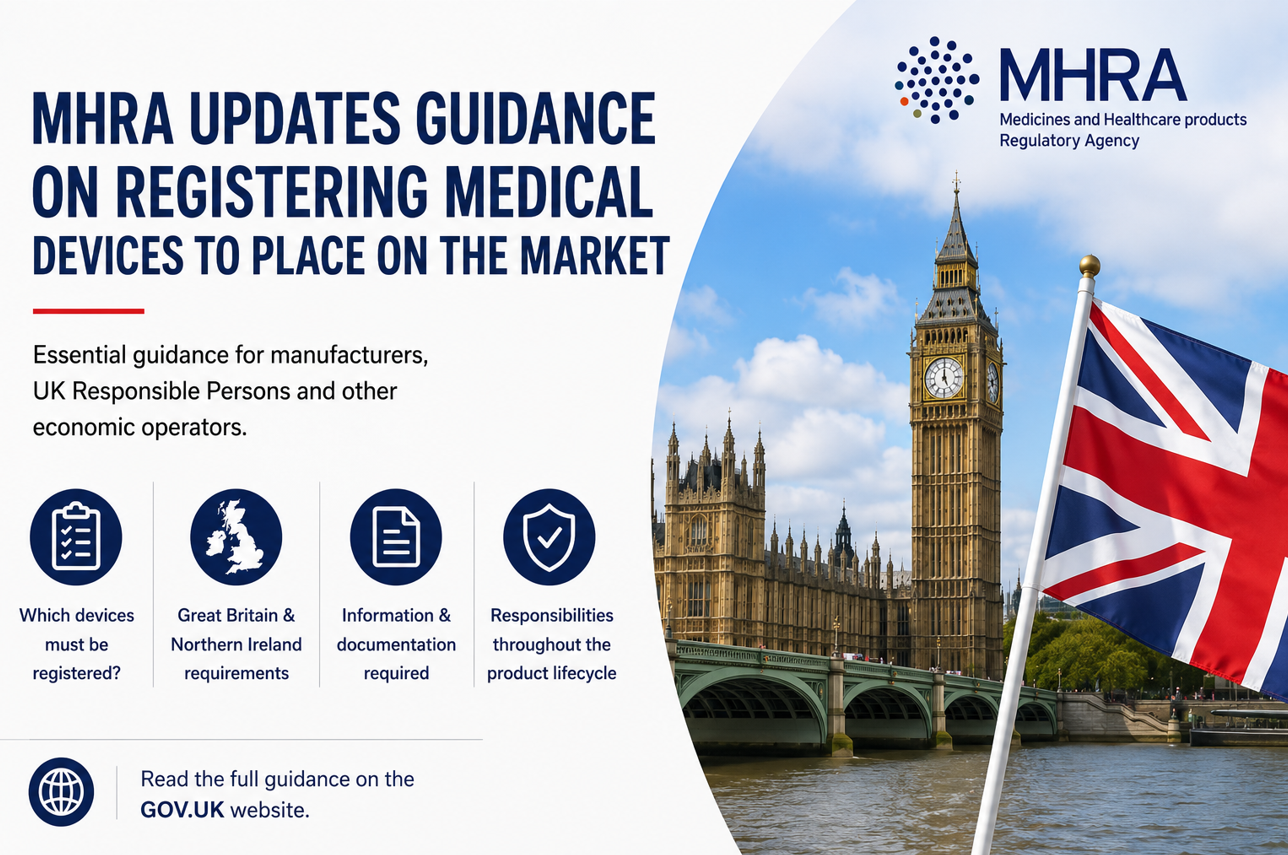
On 8 July 2026, the Medicines and Healthcare products Regulatory Agency (MHRA) updated its guidance titled “Register Medical Devices to Place on the Market.” The revised guidance provides manufacturers, UK Responsible Persons (UKRPs), importers, and other economic operators with detailed information on the registration process, documentation requirements, and responsibilities associated with placing medical devices on the markets in Great Britain and Northern Ireland.
Although many of the regulatory principles remain unchanged, the latest guidance introduces several important clarifications that manufacturers should carefully review. For companies supplying medical devices to the UK market, understanding these requirements is essential not only for initial market entry but also for maintaining ongoing regulatory compliance.
Why MHRA Registration Matters
Before a medical device can be legally supplied in Great Britain, it must generally be registered with the MHRA. Registration enables the regulator to maintain oversight of medical devices available in the UK market and supports activities such as post-market surveillance, market monitoring, safety investigations, and regulatory enforcement.
However, manufacturers should understand that registration is not simply an administrative exercise. The information submitted during registration becomes part of the regulator’s oversight activities and may be reviewed throughout the product lifecycle.
The updated guidance also reiterates an important point that is sometimes misunderstood within the industry registration with the MHRA does not represent product approval, certification, accreditation, or endorsement. Manufacturers must not promote their products as “MHRA Approved” merely because they have completed the registration process. Similarly, MHRA logos should not be used in product literature or marketing materials in a way that could mislead customers.
Which Medical Devices Must Be Registered?
The revised guidance explains that registration applies to a broad range of medical devices intended for the Great Britain market.
These include:
- Class I medical devices
- Class IIa medical devices
- Class IIb medical devices
- Class III medical devices
- In Vitro Diagnostic Medical Devices (IVDs)
- Custom-made devices
- Systems and procedure packs
- IVDs undergoing performance evaluation
Manufacturers that refurbish or relabel medical devices under their own name may also be required to register those devices. Likewise, organizations placing systems or procedure packs on the market under their own name must ensure that the applicable registration requirements are met.
The guidance therefore extends beyond traditional device manufacturers and also affects several other economic operators involved in supplying medical devices within the UK.
Great Britain Registration Requirements
For devices supplied in England, Scotland and Wales, manufacturers must notify the MHRA before placing eligible devices on the market.
This requirement applies regardless of whether devices are sold, leased, loaned, or supplied free of charge. Registration should therefore be considered a prerequisite for lawful market access rather than a post-market administrative activity.
Manufacturers established within the United Kingdom may register their own devices directly. However, manufacturers located outside the UK must appoint a single UK Responsible Person (UKRP) to act on their behalf.
The UKRP assumes responsibility for submitting registrations to the MHRA and acts as the primary regulatory contact between the overseas manufacturer and the UK authority.
For international manufacturers, selecting an experienced UKRP is therefore an important regulatory decision rather than merely an administrative requirement.
Northern Ireland Follows a Different Regulatory Pathway
One of the most significant areas addressed in the updated guidance concerns the regulatory requirements applicable to Northern Ireland.
Unlike Great Britain, Northern Ireland continues to follow certain aspects of the European medical device regulatory framework under the Windsor Framework arrangements.
The updated guidance explains that from 28 May 2026, most medical devices intended for the Northern Ireland market must first be registered in EUDAMED before they are placed on the market. Once EUDAMED registration becomes applicable, separate MHRA registration is generally no longer required for these devices.
This represents an important distinction for manufacturers marketing products across both Great Britain and Northern Ireland.
Companies supplying products throughout the UK should therefore avoid assuming that a single registration pathway applies everywhere. Instead, they should determine whether their products require:
- MHRA registration,
- EUDAMED registration, or
- both, depending on the intended market and applicable legislation.
Custom-made devices remain subject to separate requirements and continue to require MHRA registration under the circumstances described in the guidance.
The UK Responsible Person Plays a Critical Role
Following Brexit, the role of the UK Responsible Person has become central to market access for overseas manufacturers.
The updated guidance reminds manufacturers that only one UK Responsible Person may be appointed for each manufacturer.
The designation must be supported by a formal legal agreement clearly defining the responsibilities delegated to the UKRP.
These responsibilities typically include:
- Registering devices with the MHRA
- Maintaining communication with the regulator
- Keeping registration information current
- Supporting regulatory inspections or enquiries
- Acting on behalf of the manufacturer where required under UK legislation
Manufacturers should periodically review these agreements to ensure they remain valid, particularly following organizational restructuring, acquisitions, changes in legal entities, or changes in product portfolios.
What Information Must Be Submitted During Registration?
One of the most useful sections of the updated guidance is the detailed explanation of the information expected during registration.
Manufacturers should be prepared to submit:
- Manufacturer legal entity information
- Administrative contact details
- UK Responsible Person information (where applicable)
- Device classification
- Applicable legislation
- Device trade or brand name
- Model and version
- Catalogue or reference number
- Global Medical Device Nomenclature (GMDN) code
- Basic UDI-DI and UDI-DI where applicable
- UK Approved Body or EU Notified Body details
- Device characteristics such as sterility, latex content and MRI compatibility
In addition, manufacturers are expected to provide supporting regulatory documentation, including Declarations of Conformity or conformity assessment certificates where applicable.
The guidance also notes that the MHRA may request additional technical documentation during its review process. Manufacturers should therefore ensure that their technical documentation is complete, organized, and readily available.
Device Online Registration System (DORS)
All registrations are submitted through the Device Online Registration System (DORS).
Creating a DORS account is only the first step.
Registration is considered complete only after:
- Required information has been submitted,
- Supporting documentation has been provided where applicable,
- Applicable statutory fees have been paid, and
- The MHRA confirms successful registration.
Manufacturers should therefore allow sufficient time for the registration process before planning commercial launch activities.
Importers and Other Economic Operators
The updated guidance also clarifies the responsibilities of importers.
Where a Great Britain-based importer intends to import medical devices, the importer must notify the manufacturer or UK Responsible Person of its intention to place the devices on the Great Britain market.
The manufacturer or UKRP is then responsible for providing the importer’s details to the MHRA.
By contrast, distributors that do not import devices are generally not required to register with the MHRA.
Understanding these distinctions is important because the regulatory responsibilities of importers and distributors differ significantly under UK legislation.
Systems, Procedure Packs and Custom-Made Devices
Manufacturers sometimes overlook that systems, procedure packs, and custom-made devices are also subject to specific registration obligations.
Organizations placing systems or procedure packs on the market under their own name must register these products using the appropriate GMDN terminology and provide details of the constituent devices.
Similarly, custom-made devices remain subject to dedicated registration requirements, particularly where devices are supplied within Northern Ireland.
Manufacturers operating in these specialist sectors should carefully review the applicable sections of the guidance before placing products on the market.
Annual Fees and Administrative Updates
The updated guidance also includes several administrative changes.
One notable update is the extension of the 2026 Annual Fee payment deadline to 31 July 2026, providing manufacturers with additional time to adapt to the revised fee structure.
The MHRA has also indicated that further guidance will be published regarding devices that are technically classified as “put into service only,” providing greater clarity on future registration expectations.
Practical Considerations for Manufacturers
The revised guidance provides a useful opportunity for manufacturers to review their current regulatory processes.
Rather than waiting until a new product is launched, organizations should consider conducting a periodic review of their UK registrations.
Questions worth asking include:
- Are all registered products still current?
- Are device classifications correct?
- Have GMDN codes been updated where necessary?
- Is the UK Responsible Person agreement still valid?
- Is technical documentation readily available if requested by the MHRA?
- Are products intended for Northern Ireland following the correct registration pathway?
- Have importer details been maintained where applicable?
Addressing these questions proactively can reduce regulatory risk and help prevent delays during inspections, audits, or product registrations.
Final Thoughts
The July 2026 revision of the MHRA guidance does not fundamentally change the UK’s medical device registration framework. Instead, it provides clearer explanations of existing regulatory requirements while reflecting recent developments affecting Great Britain and Northern Ireland.
Manufacturers should not view this document simply as updated guidance to file away. It is an opportunity to verify that existing registrations remain accurate, responsibilities are clearly defined, and internal regulatory processes continue to align with current UK expectations.
As UK medical device regulations continue to evolve, organizations that maintain accurate registrations, robust technical documentation, and effective regulatory oversight will be better positioned to achieve uninterrupted access to one of the world’s most important medical device markets.
How MedOrdyn Solutions Can Help
At MedOrdyn Solutions, we support medical device and IVD manufacturers throughout the product lifecycle with practical, risk-based regulatory consulting services.
Our expertise includes:
- UK MDR regulatory strategy
- MHRA registration support
- UK Responsible Person coordination through trusted partners
- Device classification
- Technical documentation review
- UKCA compliance
- EU MDR and IVDR consulting
- FDA regulatory strategy
- ISO 13485 Quality Management Systems
- Global market access support
Whether you are preparing to enter the UK market for the first time or reviewing your existing registrations, our team can help you understand the regulatory requirements and develop a practical compliance strategy.
References
- Medicines and Healthcare products Regulatory Agency (MHRA). Register Medical Devices to Place on the Market. Updated 8 July 2026.
- Medical Devices Regulations 2002 (UK MDR 2002) (SI 2002 No. 618, as amended).
- MHRA Guidance – Regulating Medical Devices in the UK.
- MHRA Device Online Registration System (DORS).
- European Database on Medical Devices (EUDAMED).