
Introduction
The journey from concept to commercialization of a medical device or an in vitro diagnostic (IVD) medical device involves several stages of research, development, verification, validation, and regulatory assessment. Before a device can be manufactured for commercial sale, manufacturers often need to produce limited quantities for activities such as laboratory testing, performance evaluation, clinical investigations, demonstrations, or training. Since these devices are not intended for commercial distribution, their manufacture is regulated separately under the Medical Devices Rules, 2017.
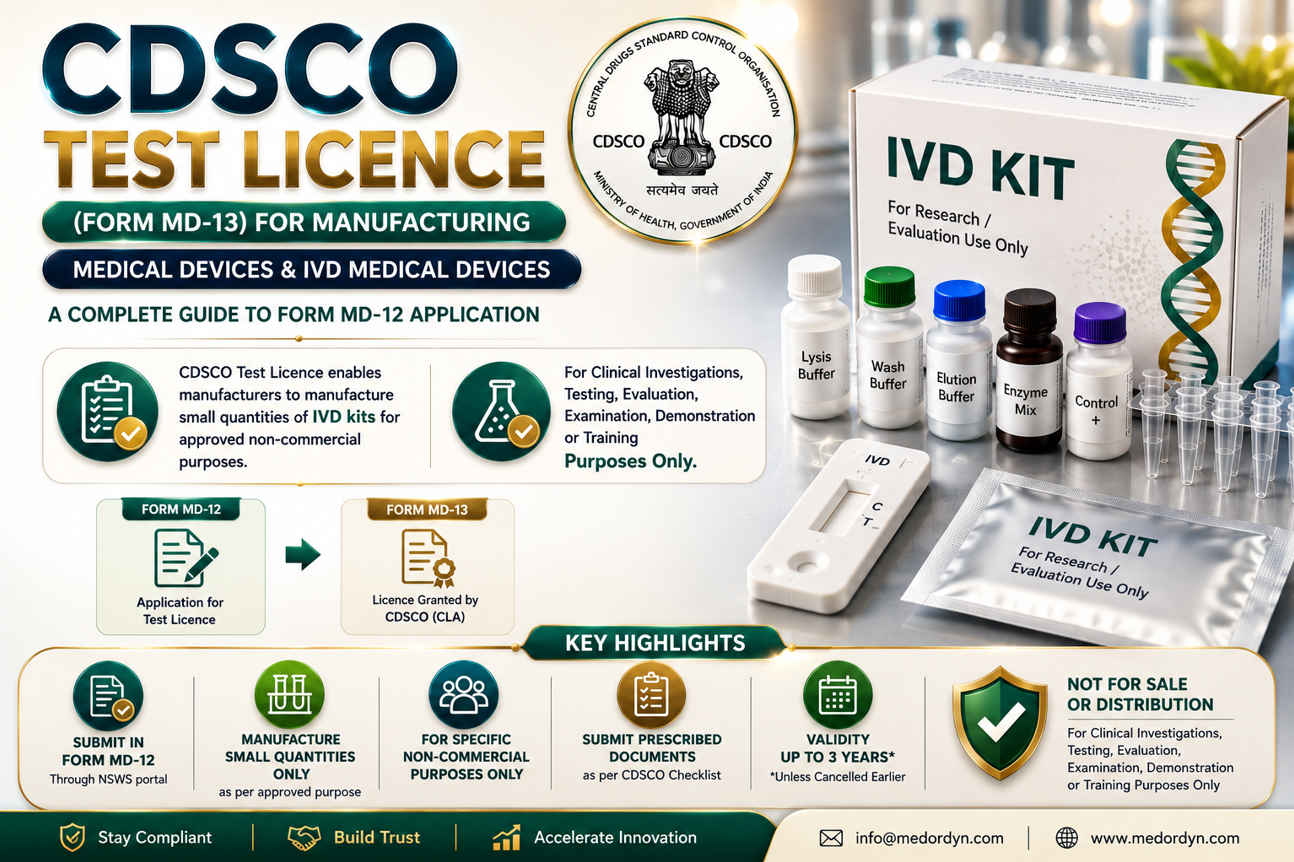
To facilitate these activities while ensuring regulatory oversight, the Central Drugs Standard Control Organization (CDSCO) provides a regulatory mechanism through a Test License. The application for the Test License is submitted in Form MD-12, and upon approval, the Central Licensing Authority (CLA) grants the license in Form MD-13.
The Test License allows manufacturers to produce limited quantities of medical devices or IVD medical devices exclusively for approved non-commercial purposes. It is an important regulatory pathway for product development, enabling manufacturers to generate technical, analytical, and clinical evidence required to support future regulatory submissions.
This article provides a comprehensive overview of the CDSCO Test License, including its purpose, regulatory framework, eligibility, application process, documentation requirements, and key considerations for manufacturers seeking a license under Form MD-13.
Scope of this Article
The provisions relating to Form MD-12 (Application) and Form MD-13 (License) under the Medical Devices Rules, 2017 apply to both medical devices and in vitro diagnostic (IVD) medical devices.
However, CDSCO may issue category-specific guidance documents or document checklists depending on the type of device and the intended purpose of manufacture. The document checklist discussed later in this article is based on the official CDSCO Form MD-12 Checklist for IVD Medical Devices. Manufacturers of non-IVD medical devices should also refer to the latest applicable guidance or requirements published by CDSCO for their respective device category.
What is a CDSCO Test License?
A CDSCO Test License is a regulatory permission granted by the Central Licensing Authority (CLA) to manufacture small quantities of a medical device or an IVD medical device exclusively for specific purposes permitted under the Medical Devices Rules, 2017.
The license is issued in Form MD-13 following submission and approval of an application in Form MD-12.
The Test License is intended to support product development and regulatory evaluation activities. It does not authorize commercial manufacture, sale, or distribution of the device. Products manufactured under this license must only be used for the purpose approved by the Central Licensing Authority.
Purpose of the Test License
The Test Licence enables manufacturers to legally manufacture limited quantities of medical devices or IVD medical devices before obtaining a commercial manufacturing licence.
Depending on the stage of product development, the licence may be required for activities such as:
- Clinical investigations.
- Clinical performance evaluation (applicable to IVD medical devices).
- Laboratory testing.
- Product evaluation.
- Engineering verification.
- Analytical validation.
- Examination.
- Product demonstration.
- User or operator training.
- Research and development activities.
For example:
- A manufacturer developing a new infusion pump may require a Test Licence to manufacture devices for engineering evaluation or clinical investigation.
- A company developing an HPV molecular diagnostic kit may require a Test Licence to manufacture limited quantities for analytical validation or clinical performance evaluation before applying for commercial manufacturing approval.
In each case, the device is manufactured solely for the approved investigational or evaluation purpose and not for commercial sale.
Regulatory Framework
The Test License is governed by the Medical Devices Rules, 2017, which were notified under the Drugs and Cosmetics Act, 1940.
Under these Rules:
- Applications are submitted in Form MD-12.
- The license is issued in Form MD-13 by the Central Licensing Authority.
- The licence permits manufacture only for the approved purpose specified in the application.
- The quantity manufactured should be limited to that required for the intended activity.
Applicants should always refer to the latest version of the Medical Devices Rules, 2017, together with any amendments, notifications, or guidance documents issued by CDSCO.
Regulatory Authority
The authority responsible for granting the Test Licence is the:
Central Licensing Authority (CLA)
Central Drugs Standard Control Organization (CDSCO)
The Central Licensing Authority reviews each application individually and may seek additional information or clarification before taking a decision.
Where necessary, applicants may be required to submit revised documents or respond to regulatory queries during the review process.
Applicable Forms
The CDSCO Test License process under the Medical Devices Rules, 2017 involves two statutory forms. The applicant must submit the application in Form MD-12, along with the prescribed supporting documents and applicable government fee. Upon satisfactory review of the application, CDSCO grants the Test License in Form MD-13, authorising the manufacture of medical devices or IVD medical devices for clinical investigation, test, evaluation, examination, demonstration, or training purposes.
Who Can Apply?
The Test Licence may be required by organizations involved in the research, development, testing, or evaluation of medical devices or IVD medical devices.
Applicants may include:
- Medical device manufacturers.
- In vitro diagnostic (IVD) manufacturers.
- Biotechnology companies.
- Start-up companies developing innovative medical technologies.
- Research and development organizations.
- Academic institutions.
- Government research laboratories.
- Medical device innovators.
- Organizations conducting clinical investigations or performance evaluation studies.
Applicants should ensure that they possess or have access to suitable manufacturing facilities, equipment, instruments, and qualified personnel necessary for the proposed manufacturing activities.
When is a Test License Required?
A Test Licence is generally required whenever limited quantities of a medical device or IVD medical device are manufactured exclusively for non-commercial purposes.
Typical situations include:
Clinical Investigations
Manufacturing investigational devices intended to be used during clinical investigations conducted in accordance with applicable regulatory requirements.
Clinical Performance Evaluation
For IVD medical devices, manufacturers may require limited quantities of the device for clinical performance evaluation studies designed to establish diagnostic performance.
Product Testing
Manufacturing devices required for laboratory testing, analytical testing, engineering verification, or performance assessment.
Product Evaluation
Producing devices for internal technical evaluation or external assessment before commercial manufacturing.
Demonstration
Manufacturing devices for demonstration to healthcare professionals, investigators, distributors, or regulatory authorities.
Training
Producing devices for the training of healthcare professionals, laboratory personnel, service engineers, or end users.
Activities Not Permitted Under the Test License
Manufacturers should clearly understand the limitations of the Test Licence.
The license does not permit:
- Commercial manufacture.
- Commercial sale.
- Commercial distribution.
- Routine production for market supply.
- Marketing of the device.
The medical device or IVD medical device manufactured under Form MD-13 should only be used for the purpose approved by the Central Licensing Authority.
Application Portal
CDSCO has integrated several medical device licensing services with the National Single Window System (NSWS).
Applications for obtaining a Test License under Form MD-12 are submitted electronically through the NSWS portal, together with the prescribed documents and applicable government fee.
Before initiating the application, manufacturers should ensure that:
- The organization is registered on the NSWS portal.
- All mandatory documents are available in the prescribed format.
- Information provided in the application is complete and consistent.
- Supporting documents are legible and properly authenticated, wherever applicable.
Applicants should also verify the latest submission procedure published by CDSCO, as online regulatory platforms may be updated from time to time.
Government Fee
As prescribed under the Second Schedule of the Medical Devices Rules, 2017, the government fee for obtaining a Test License to manufacture a medical device or IVD medical device for the purpose of clinical investigations, testing, evaluation, examination, demonstration, or training is ₹500 for each distinct medical device or IVD medical device. The prescribed fee must be paid electronically through the designated online application portal at the time of submitting the application.
Application Process
Obtaining a Test Licence involves a structured regulatory review process. While individual applications may vary depending on the device and intended purpose, the general process is as follows.
Step 1 – Registration on NSWS
Register the applicant organization on the National Single Window System (NSWS) portal and access the CDSCO medical device licensing services.
Step 2 – Submission of Form MD-12
Complete Form MD-12 by providing details of:
- The applicant.
- Manufacturing site.
- Medical device or IVD medical device.
- Purpose of manufacture.
- Proposed manufacturing quantity.
Step 3 – Upload Supporting Documents
Upload all mandatory supporting documents specified in the applicable CDSCO checklist.
The documentation should be complete, technically consistent, and clearly legible.
Step 4 – Payment of Government Fee
Pay the prescribed government fee electronically through the portal.
Step 5 – Technical Review by CDSCO
The Central Licensing Authority reviews the application and supporting documentation.
Where necessary, CDSCO may seek additional information or clarification through the online portal.
Step 6 – Response to Regulatory Queries
Applicants should respond promptly to any observations or deficiencies communicated by CDSCO by submitting revised or additional documentation.
Step 7 – Grant of Test License
If the application complies with the applicable provisions of the Medical Devices Rules, 2017, the Central Licensing Authority grants the Test License in Form MD-13.
Documents Required for Form MD-12
A complete and well-organized application is one of the key factors in facilitating the review of a Test License application by the Central Licensing Authority (CLA). While the Medical Devices Rules, 2017 prescribe the application in Form MD-12, CDSCO has also published category-specific document checklists to assist applicants in preparing their submissions. For both medical devices and IVD medical devices, applicants should refer to the latest checklist applicable to their product category available on the CDSCO website.
The explanations below are based primarily on the official CDSCO Form MD-12 Checklist for IVD Medical Devices. Manufacturers of non-IVD medical devices should refer to the corresponding Form MD-12 Medical Device Checklist, as certain documentation requirements may differ.
1. Covering Letter (Mandatory)
The application should be accompanied by a covering letter addressed to the Central Licensing Authority.
The covering letter should briefly mention:
- Purpose of the application.
- Name of the medical device or IVD medical device.
- Purpose of manufacturing under the Test License.
- Details of the manufacturing site.
- List of enclosed documents.
A clear covering letter provides an overview of the application and helps the reviewing authority understand the objective of the submission.
2. Brief Description of the Medical Device or IVD Medical Device (Mandatory)
Applicants should provide a concise description of the product proposed to be manufactured.
Depending on the type of device, the description should include:
- Device name.
- Generic name.
- Intended use.
- Design.
- Material of construction.
- Principle of operation, where applicable.
- Product specifications.
- Accessories, if any.
For IVD medical devices, the intended use statement should clearly identify:
- Target analyte.
- Specimen type.
- Intended user.
- Intended testing environment.
- Diagnostic purpose.
The description should provide sufficient technical information for CDSCO to understand the nature and intended application of the device.
3. Quality Certificates of the Raw Material Manufacturer (Mandatory, Where Applicable)
The IVD checklist requires applicants to submit available quality certificates relating to the manufacturer supplying raw materials, wherever applicable.
Examples may include:
- Quality Management System (QMS) certificates.
- ISO certifications.
- Supplier quality certifications.
- Other relevant quality assurance certificates.
Where such certificates are not applicable, applicants should ensure that the submission appropriately reflects the nature of the raw materials being procured.
4. Undertaking Regarding Manufacturing Facilities (Optional)
According to the current CDSCO IVD checklist, this document is not mandatory. However, applicants may submit an undertaking confirming that adequate:
- Manufacturing facilities.
- Equipment.
- Instruments.
- Qualified personnel.
are available for manufacturing the proposed device.
Although optional, the undertaking demonstrates the applicant’s preparedness to manufacture the device under suitable conditions.
5. List of Equipment and Instruments (Mandatory)
Applicants should provide a list of the equipment and instruments available for manufacturing and testing the proposed medical device or IVD medical device.
The list should be relevant to the proposed manufacturing activity and may include:
- Equipment name.
- Make or model.
- Quantity.
- Intended use.
- Calibration status, where applicable.
The objective is to demonstrate that appropriate infrastructure is available to manufacture and evaluate the device.
6. List of Qualified Personnel (Mandatory)
The application should include details of personnel responsible for manufacturing and quality-related activities.
Typical information includes:
- Name.
- Designation.
- Educational qualification.
- Relevant experience.
- Functional responsibility.
The list should cover personnel involved in:
- Manufacturing.
- Quality Assurance.
- Quality Control.
- Testing.
This information enables CDSCO to assess whether suitably qualified personnel are available for the proposed activity.
7. Justification of the Quantity Proposed to be Manufactured (Mandatory)
One of the most important documents in the application is the justification for the quantity proposed to be manufactured.
Since the Test Licence permits manufacture of limited quantities, applicants should provide a clear and scientific justification explaining why the requested quantity is necessary.
The justification should include:
- Total quantity proposed.
- Intended utilization.
- Purpose of manufacture.
- Distribution of the quantity across the proposed activities.
For example, the quantity may be required for:
- Clinical investigations.
- Clinical performance evaluation.
- Laboratory testing.
- Validation studies.
- Demonstration.
- Training.
The proposed quantity should be reasonable and proportionate to the intended purpose.
8. Test Protocol (Mandatory, Where Applicable)
Applicants should submit the protocol describing the proposed testing or evaluation activity.
Depending on the intended purpose, this may include:
- Clinical investigation protocol.
- Clinical performance evaluation protocol.
- Analytical performance study.
- Validation protocol.
- Verification protocol.
- Test specifications.
- Applicable standards.
For medical devices, the corresponding MD-12 checklist also expects submission of the test specification and protocol along with applicable standards.
A well-defined protocol helps demonstrate that the proposed manufacturing activity has a clear scientific or technical objective.
9. Copy of Existing Manufacturing License (Mandatory, Where Applicable)
Where the applicant already holds a manufacturing licence issued under the Medical Devices Rules, a copy should be submitted along with the application.
This enables CDSCO to verify the applicant’s existing regulatory status.
If no manufacturing license has previously been granted, the applicant may indicate that the document is not applicable.
10. Approval Letter for Research and Development Activities (Mandatory, Where Applicable)
Where applicable, applicants should submit an approval letter issued by a Government organization authorizing them to undertake research and development activities.
This requirement is particularly relevant where the proposed manufacturing activity is being carried out under a Government-supported research programme or institutional project.
11. Other Supporting Documents (Optional)
Applicants may submit any additional documents considered relevant to support the application.
Depending on the product, these may include:
- Product literature.
- Device photographs.
- Technical drawings.
- Manufacturing flow diagrams.
- Scientific publications.
- Additional technical information.
Although optional, such documents can assist the reviewing authority in understanding the proposed device and manufacturing activity.
12. Fee Challan (Mandatory)
Proof of payment of the prescribed government fee should be submitted along with the application.
Applicants should ensure that:
- The correct fee has been paid.
- The payment receipt is legible.
- The receipt corresponds to the submitted application.
13. Legal Form (Mandatory)
The applicant should submit documents establishing the legal status of the organization.
Depending on the constitution of the organization, this may include:
- Certificate of Incorporation.
- Partnership Deed.
- LLP Registration Certificate.
- Proprietorship Declaration.
- Society Registration Certificate.
- Trust Registration Certificate.
These documents establish the legal identity of the applicant submitting Form MD-12.
Preparing a Complete Regulatory Submission
Before submitting Form MD-12, applicants should perform a thorough review of the dossier to ensure that all information is complete, accurate, and internally consistent.
It is advisable to verify that:
- The intended use is consistently described throughout the application.
- The proposed manufacturing quantity is supported by an appropriate justification.
- The submitted protocol aligns with the purpose of manufacture.
- Mandatory documents are complete and properly signed, where applicable.
- Supporting documents are clear, legible, and correspond to the relevant checklist item.
Preparing a structured and technically consistent application can facilitate the regulatory review process and help reduce the need for additional clarification during evaluation.
Review of the Application by CDSCO
After the application in Form MD-12 is submitted through the National Single Window System (NSWS) along with the prescribed documents and government fee, it is reviewed by the Central Licensing Authority (CLA) under the provisions of the Medical Devices Rules, 2017.
During the review process, CDSCO evaluates whether:
- The application has been completed correctly.
- All mandatory documents have been submitted.
- The proposed purpose of manufacture is consistent with the provisions of the Medical Devices Rules, 2017.
- The proposed quantity is appropriate for the intended activity.
- The technical information submitted is complete and consistent.
- The applicant has provided sufficient supporting documentation for regulatory evaluation.
If additional information or clarification is required, the Central Licensing Authority may raise queries through the online portal. Applicants are expected to respond by submitting the requested information or revised documents within the prescribed timeline.
Upon satisfactory review of the application and supporting documentation, the Central Licensing Authority may grant the Test License in Form MD-13.
Grant of Test License
If the Central Licensing Authority is satisfied that the applicant has complied with the applicable requirements under the Medical Devices Rules, 2017, the Test Licence is granted in Form MD-13.
The licence specifies:
- Name of the license holder.
- Address of the manufacturing site.
- Name of the medical device or IVD medical device.
- Purpose for which the license has been granted.
- Conditions applicable to the licence.
The license authorizes manufacture only for the activities approved by the licensing authority and should not be interpreted as permission for commercial manufacture or marketing of the device.
Validity of the License
As provided under the Medical Devices Rules, 2017, a Test License granted in Form MD-13 is valid for a period of three years from the date of its issue, unless it is suspended or cancelled by the Central Licensing Authority.
Manufacturers should ensure continued compliance with the applicable provisions of the Medical Devices Rules and any conditions specified in the license throughout its validity period.
Responsibilities of the License Holder
Obtaining a Test Licence is not the final step in the regulatory process. The licence holder is responsible for ensuring that all manufacturing activities remain within the scope approved by CDSCO.
Some of the important responsibilities include:
Manufacture Only for the Approved Purpose
Medical devices or IVD medical devices manufactured under the Test Licence should only be used for the purpose approved in the licence, such as:
- Clinical investigations.
- Clinical performance evaluation.
- Testing.
- Evaluation.
- Examination.
- Demonstration.
- Training.
The license should not be used for routine commercial manufacturing.
Manufacture Only the Required Quantity
Applicants should manufacture only the quantity reasonably required for the approved activity.
Any significant deviation from the approved purpose or manufacturing quantity may require appropriate regulatory approval.
Maintain Manufacturing Records
The licence holder should maintain appropriate records relating to the manufacture of devices under the Test Licence.
These records may include:
- Batch details.
- Quantity manufactured.
- Quantity issued.
- Date of manufacture.
- Purpose of use.
- Distribution details, where applicable.
Proper record maintenance supports traceability and facilitates regulatory inspections, if required.
Maintain Appropriate Quality Controls
Although devices manufactured under the Test License are not intended for commercial sale, they should still be manufactured under appropriate quality controls to ensure that they are suitable for the intended investigational or evaluation purpose.
Comply with License Conditions
The license holder should comply with all conditions specified in the license and any additional requirements communicated by the Central Licensing Authority.
Common Reasons for CDSCO Queries
The quality of the application has a direct impact on the efficiency of the regulatory review.
Some of the common reasons for regulatory queries include:
- Incomplete application form.
- Missing mandatory documents.
- Inadequate device description.
- Unclear intended use.
- Insufficient justification for the proposed manufacturing quantity.
- Inconsistencies between Form MD-12 and supporting documents.
- Incomplete test protocol.
- Missing information relating to qualified personnel.
- Illegible uploaded documents.
Applicants should carefully review the complete dossier before submission to minimize avoidable deficiencies.
Best Practices for Preparing a Test License Application
A well-prepared application not only facilitates regulatory review but also reflects the applicant’s commitment to compliance.
The following practices are recommended:
- Refer to the latest version of the Medical Devices Rules, 2017.
- Download the latest applicable CDSCO checklist before preparing the dossier.
- Ensure consistency across all submitted documents.
- Clearly justify the proposed manufacturing quantity.
- Submit technically complete protocols.
- Upload clear and legible documents.
- Verify that all mandatory documents have been included.
- Respond promptly to regulatory queries raised by CDSCO.
Early planning and careful documentation can significantly improve the quality of the submission.
Frequently Asked Questions (FAQs)
- What is the purpose of a CDSCO Test License?
A Test Licence permits manufacturers to produce limited quantities of medical devices or IVD medical devices exclusively for clinical investigations, testing, evaluation, examination, demonstration, or training. It does not authorize commercial manufacture or sale.
- Which application form should be used?
Applications are submitted in Form MD-12.
Upon approval, the Central Licensing Authority grants the licence in Form MD-13.
- Is the Test License applicable only to IVD medical devices?
No. The provisions relating to Form MD-12 and Form MD-13 under the Medical Devices Rules, 2017 apply to both medical devices and IVD medical devices.
However, applicants should refer to the latest CDSCO checklist or guidance applicable to their specific device category while preparing the application.
- Can products manufactured under a Test License be sold commercially?
No.
Medical devices or IVD medical devices manufactured under Form MD-13 are intended only for the approved non-commercial purpose specified in the licence.
- Where should the application be submitted?
Applications are submitted electronically through the National Single Window System (NSWS) portal, as notified by CDSCO for the applicable services.
Applicants should verify the latest submission procedure on the CDSCO website before applying.
- What is the government fee for a Test License?
As prescribed under the Medical Devices Rules, 2017, the government fee is ₹500 for each distinct medical device or IVD medical device covered under the application.
- Is ISO 13485 certification mandatory for obtaining a Test License?
The Medical Devices Rules, 2017 do not specifically prescribe ISO 13485 certification as a mandatory requirement for obtaining a Test Licence under Form MD-13.
However, applicants should ensure that suitable manufacturing facilities, equipment, and qualified personnel are available to support the proposed manufacturing activities.
- What should applicants do if CDSCO raises a query?
Applicants should carefully review the observations communicated by CDSCO and submit complete responses along with any revised or additional supporting documents through the designated online portal.
Conclusion
The CDSCO Test License provides an important regulatory pathway for manufacturers developing medical devices and in vitro diagnostic (IVD) medical devices in India. It enables the manufacture of limited quantities of devices for clinical investigations, clinical performance evaluations, testing, evaluation, examination, demonstration, and training while ensuring that these activities are carried out under the regulatory framework established by the Medical Devices Rules, 2017.
Although the application process is relatively straightforward, preparing a complete and technically consistent Form MD-12 submission requires careful planning and attention to detail. Applicants should ensure that the intended use, proposed manufacturing quantity, supporting technical documentation, and study protocols are aligned with the purpose of the application. Referring to the latest CDSCO guidance documents, category-specific checklists, and official notifications is essential to ensure compliance with current regulatory requirements.
As India’s medical device regulatory framework continues to evolve, manufacturers should remain informed of updates issued by CDSCO and adopt a proactive approach to regulatory compliance throughout the product development lifecycle.
How MedOrdyn Can Help
Preparing a CDSCO Test License (Form MD-12/MD-13) application requires accurate documentation and a clear understanding of regulatory requirements.
MedOrdyn supports medical device and IVD manufacturers with:
- Form MD-12 application support
- Technical documentation review
- Regulatory gap assessment
- Response to CDSCO queries
- Clinical investigation and performance evaluation support
- Guidance on subsequent CDSCO approvals
Whether you’re a start-up or an established manufacturer, our regulatory experts can help streamline your regulatory journey.
Need assistance with your Test License application?
📧 info@medordyn.com
🌐 www.medordyn.com
References
This article has been prepared with reference to the following official sources:
- Medical Devices Rules, 2017 (as amended), Ministry of Health & Family Welfare, Government of India.
- Central Drugs Standard Control Organization (CDSCO) – Medical Devices Division.
- CDSCO Form MD-12 Checklist (Medical Devices and IVDs, as applicable).