
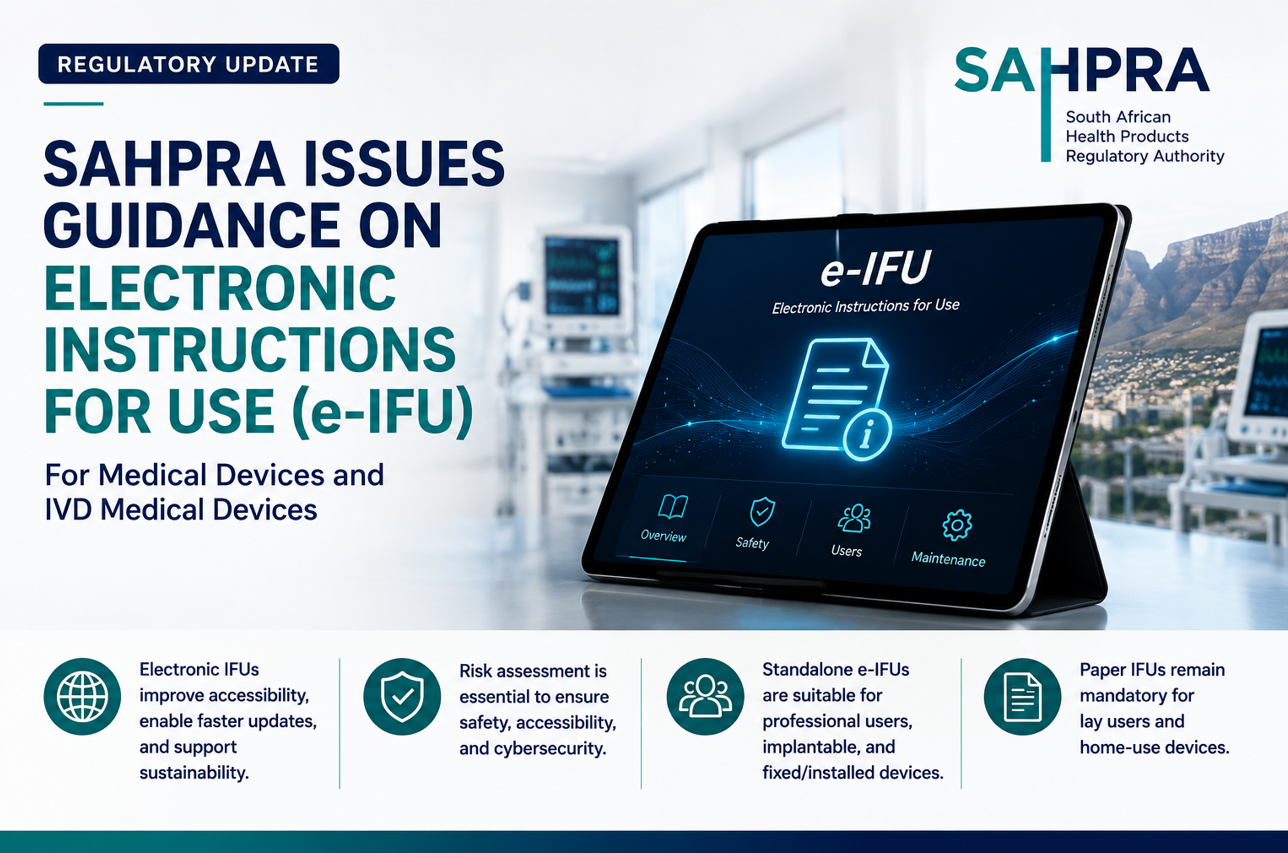
The South African Health Products Regulatory Authority (SAHPRA) has published a communication outlining its regulatory expectations for the use of Electronic Instructions for Use (e-IFU) for medical devices and in vitro diagnostic (IVD) medical devices. Released on 8 May 2026, the guidance provides greater clarity on when electronic instructions may be used, the associated responsibilities of manufacturers, and the circumstances in which paper Instructions for Use (IFUs) continue to be necessary.
The use of electronic documentation has steadily increased as medical devices become more digital, connected, and software-driven. Manufacturers are increasingly exploring electronic IFUs as an alternative to printed instructions to improve document management and simplify product updates. However, while digital documentation offers several advantages, its implementation must continue to ensure patient safety, accessibility, and regulatory compliance.
This latest communication provides practical direction for manufacturers planning to introduce e-IFUs in the South African market and highlights several important regulatory considerations.
Why Electronic IFUs Are Becoming More Common
Traditional paper IFUs have long been a standard component of medical device labelling. However, maintaining printed documentation across multiple markets, languages, and product versions can be both resource-intensive and time-consuming. Every update often requires reprinting and redistribution, increasing operational costs and creating the risk that outdated instructions remain in circulation.
Electronic IFUs offer a practical alternative. By providing instructions through a manufacturer’s website, dedicated software, the device itself, or portable electronic media, manufacturers can update information more efficiently while ensuring users have access to the latest approved version.
The guidance also acknowledges several advantages associated with electronic instructions, including easier document updates, searchable content, improved accessibility features, multimedia support such as videos and animations, and reduced paper consumption. These benefits can improve the user experience while supporting environmental sustainability initiatives.
SAHPRA’s Expectations for Electronic IFUs
Although SAHPRA recognises the benefits of digital documentation, the Authority makes it clear that electronic IFUs should not simply replace paper instructions without careful consideration.
The guidance explains that an electronic IFU may be supplied through various electronic platforms, provided the information remains complete, accurate, and readily available to the intended user. Regardless of the delivery method, manufacturers remain responsible for ensuring that users can safely access the information whenever it is required for the correct use of the device.
The communication also reinforces that all applicable regulatory information normally included within a paper IFU must continue to be available when using an electronic format. The method of delivery may change, but the manufacturer’s regulatory responsibilities do not.
Risk Assessment Is Central to e-IFU Implementation
Perhaps the most important message throughout the guidance is the need for a documented risk assessment before implementing electronic IFUs.
Rather than viewing electronic instructions as a straightforward replacement for printed documentation, manufacturers should evaluate whether the intended users can consistently access and understand the information throughout the product’s lifecycle.
SAHPRA expects manufacturers to consider factors such as the intended users, the environment in which the device will be used, internet availability, compatibility with electronic devices, cybersecurity considerations, and the potential consequences if electronic access becomes unavailable. Manufacturers should also demonstrate that providing instructions electronically offers an equivalent level of safety and effectiveness when compared with traditional paper IFUs.
The guidance further states that manufacturers should clearly indicate how users can access the electronic instructions and, where applicable, provide paper copies upon request without unnecessary delay. Appropriate document control procedures, version management, and change history should also be maintained as part of the Quality Management System.
When Can Electronic IFUs Be Used?
The communication identifies situations where standalone electronic IFUs may be appropriate.
These generally include medical devices intended exclusively for professional users, implantable devices used with the involvement of healthcare professionals, and permanently installed medical devices. In these situations, users are generally expected to have reliable access to electronic information and sufficient technical knowledge to use it appropriately.
However, SAHPRA also recognises that electronic instructions may not always be suitable. Devices intended for home use, self-testing products, and products used by lay persons typically continue to require paper IFUs. Similar considerations apply where users may experience difficulty accessing electronic information because of limited internet connectivity, digital literacy, or other accessibility challenges.
Manufacturers should therefore evaluate each product individually rather than applying a single documentation strategy across their entire product portfolio.
A Global Perspective on e-IFUs
One particularly useful aspect of SAHPRA’s communication is its comparison of electronic IFU requirements across several international jurisdictions. The document references regulatory approaches adopted in the European Union, the United States, Australia, Canada, Japan, Saudi Arabia, Singapore, Malaysia, Brazil, South Korea, and India.
While many regulatory authorities now recognise electronic instructions, their implementation requirements are not identical. Eligibility criteria, product categories, accessibility requirements, and expectations for paper IFUs vary between markets.
For manufacturers supplying products globally, this comparison serves as a useful reminder that compliance strategies should always consider country-specific regulatory requirements rather than assuming that one approach will satisfy every regulator.
Considerations for Manufacturers
Manufacturers planning to introduce electronic IFUs should view this guidance as an opportunity to review their existing labelling and documentation processes.
In addition to performing a documented risk assessment, organisations should evaluate whether their products are appropriate for electronic instructions, ensure that Quality Management System procedures adequately address document control and version management, and establish processes for maintaining previous versions and providing paper IFUs where required.
For organisations marketing products internationally, harmonising documentation while addressing jurisdiction-specific requirements will continue to be an important part of regulatory planning.
Conclusion
SAHPRA’s latest communication reflects the continuing transition towards digital medical device documentation while maintaining a strong focus on patient safety and regulatory compliance. The guidance recognises the advantages of electronic IFUs but also emphasises that their implementation should be supported by appropriate risk management, effective document control, and careful consideration of the intended users.
As digital technologies continue to reshape the medical device industry, manufacturers should proactively review their documentation strategies to ensure they remain aligned with evolving regulatory expectations. Early planning, robust risk assessment, and well-controlled quality processes will help organisations implement electronic IFUs while maintaining compliance and supporting the safe use of their medical devices.
Reference
Regulatory Requirements for Medical Devices Electronic Instructions for Use (e-IFU) – SAHPRA
How MedOrdyn Solutions Can Help
MedOrdyn Solutions supports medical device and IVD manufacturers with regulatory strategy, technical documentation, medical device labelling and IFU reviews, ISO 14971 risk management, Quality Management System compliance, and global market access.
Whether you are evaluating the implementation of electronic IFUs or reviewing your existing documentation to meet regulatory requirements, our team can help you develop a practical and compliant regulatory strategy.
Contact Us
📧 info@medordyn.com
🌐 www.medordyn.com