
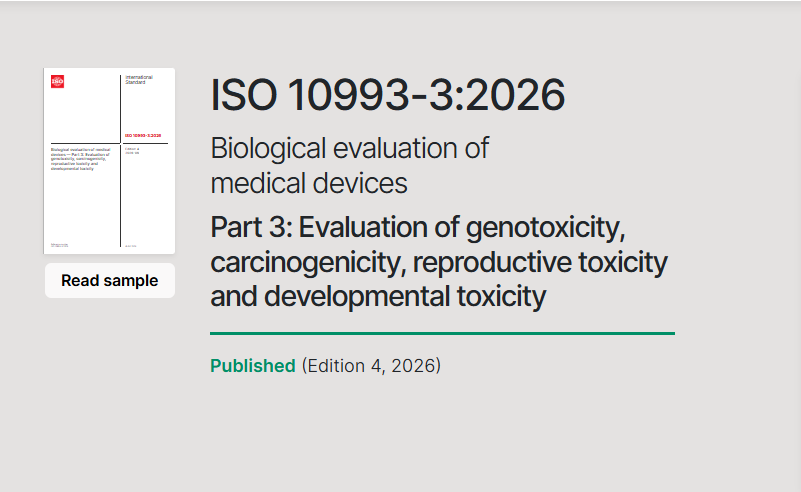
The International Organization for Standardization (ISO) has published ISO 10993-3:2026, Biological evaluation of medical devices — Part 3: Evaluation of genotoxicity, carcinogenicity, reproductive toxicity and developmental toxicity.
The fourth edition replaces ISO 10993-3:2014 and incorporates relevant guidance previously addressed in ISO/TR 10993-33:2015.
The revised standard represents an important update to the biological evaluation of medical devices. It reinforces a risk-based and scientifically justified approach, in which chemical characterization, patient exposure, toxicological information and available biological evidence are considered together when evaluating potential biological harms.
For medical device manufacturers, the key consideration is not simply which biological tests should be performed, but whether the available evidence is sufficient to address the identified biological risks and whether additional testing is scientifically necessary.
Scope of ISO 10993-3:2026
ISO 10993-3:2026 specifies strategies for the risk estimation and evaluation of biological harms relating to four important toxicological endpoints:
- Genotoxicity
- Carcinogenicity
- Reproductive toxicity
- Developmental toxicity
The standard applies when the need to evaluate a medical device for one or more of these biological effects has been established as part of the overall biological evaluation.
Therefore, the publication of ISO 10993-3:2026 should not be interpreted as requiring every medical device to undergo testing for all four endpoints.
The evaluation should consider the characteristics of the medical device, its materials and chemical constituents, the nature and duration of patient exposure, available toxicological information, existing biological evidence and any remaining uncertainties.
Key Changes in ISO 10993-3:2026
- Greater Emphasis on Risk-Based Biological Evaluation
One of the important aspects of the revised standard is its emphasis on the evaluation of biological risk rather than testing alone.
Biological safety decisions should consider relevant and available scientific information before determining whether additional testing is necessary.
The evaluation may include:
- Material composition
- Chemical characterization data
- Extractables and leachables, where relevant
- Degradation products
- Nature and duration of patient exposure
- Available toxicological information
- Existing biological test results
- Relevant scientific literature
- Other available biological safety evidence
Biological testing continues to have an important role where existing information is insufficient to adequately address an identified biological hazard.
The objective is not to eliminate testing, but to ensure that testing is scientifically justified and integrated into the overall biological evaluation strategy.
The important question for manufacturers is therefore:
Does the available chemical, toxicological and biological evidence adequately address the identified risk, or is additional evaluation or testing necessary?
2. Greater Role for Chemical Characterization and Toxicological Risk Assessment
ISO 10993-3:2026 reinforces the importance of chemical information and toxicological assessment when evaluating biological safety.
Chemical characterization performed within the ISO 10993 framework can provide information about substances that are present in, or potentially released from, a medical device.
This information can be considered together with patient exposure and available toxicological data to determine whether the relevant biological endpoints have been adequately addressed.
Chemical characterization should therefore not be viewed as an isolated analytical exercise. The resulting information can contribute directly to the toxicological and biological evaluation of the device.
Similarly, toxicological risk assessment can help determine whether exposure to identified chemical constituents presents a biological concern and whether additional information is necessary.
This integrated approach supports a scientifically justified determination of whether further biological testing is required.
3. Revised Approach to Genotoxicity Evaluation
Genotoxicity remains an important biological safety consideration because damage to genetic material may potentially contribute to mutagenic or carcinogenic effects.
ISO 10993-3:2026 revises the approach to genotoxicity evaluation, including the assessment of positive in vitro genotoxicity findings.
The previous follow-up flowchart has been removed, allowing the evaluation to consider the available evidence in the context of the medical device, its chemical constituents, patient exposure and relevant toxicological information.
This supports a more integrated assessment rather than relying solely on a predetermined sequence of follow-up tests.
Manufacturers should therefore review existing:
- Genotoxicity evaluation procedures
- Biological evaluation SOPs
- Internal decision trees
- Testing strategies
- Procedures for evaluating positive in vitro results
- Biological Evaluation Plans
- Biological Evaluation Reports
Procedures developed around the previous edition should be assessed to determine whether they remain appropriate under ISO 10993-3:2026.
4. Carcinogenicity Evaluation
Carcinogenicity is another important long-term biological endpoint addressed by ISO 10993-3:2026.
The revised approach supports consideration of carcinogenicity within the broader context of chemical, toxicological and biological evidence.
Where carcinogenicity is identified as a relevant endpoint, manufacturers should evaluate whether the available evidence adequately addresses the potential hazard associated with the medical device and its chemical constituents.
The assessment should consider the nature and level of patient exposure and should be supported by an appropriate scientific rationale.
The objective is to determine whether the available information is sufficient to address the carcinogenicity concern or whether additional evaluation is necessary.
5. Reproductive and Developmental Toxicity Are Distinct Considerations
A notable change in ISO 10993-3:2026 is the explicit inclusion of developmental toxicity in the title and scope of the standard.
Reproductive toxicity and developmental toxicity should therefore receive appropriate consideration as distinct biological endpoints.
Where applicable, manufacturers may need to consider factors such as:
- Nature and duration of exposure
- Potential systemic exposure
- Device materials and chemical constituents
- Intended patient population
- Available reproductive toxicology information
- Available developmental toxicology information
- Potential exposure during developmentally sensitive periods
The applicability of each endpoint should be scientifically justified based on the device, its intended use and expected patient exposure.
Manufacturers should therefore avoid treating reproductive and developmental toxicity merely as a single generic checklist item without considering the relevance of each endpoint individually.
6. Incorporation of ISO/TR 10993-33:2015
Relevant guidance previously contained in ISO/TR 10993-33:2015, which addressed genotoxicity testing of medical devices, has been incorporated into the revised ISO 10993-3.
ISO/TR 10993-33:2015 has subsequently been withdrawn.
Manufacturers whose existing biological evaluation documentation or procedures reference ISO/TR 10993-33:2015 should review those references and determine whether updates are necessary.
Documents that may require review include:
- Biological Evaluation Plans (BEPs)
- Biological Evaluation Reports (BERs)
- Biocompatibility procedures
- Genotoxicity evaluation procedures
- Internal SOPs
- Testing strategies
- Risk management documentation
- Technical documentation
The review should not be limited to replacing a reference to the withdrawn document. Manufacturers should also determine whether the underlying evaluation methodology and scientific rationale remain aligned with ISO 10993-3:2026.
7. Removal of the Cellular Transformation Annex
The previous annex addressing cellular transformation has been removed from the revised edition.
Manufacturers using internal procedures, decision trees or biological evaluation strategies based on content from the previous annex should review those documents and determine whether changes are necessary.
This is another reason why implementation of ISO 10993-3:2026 should involve a structured assessment rather than simply updating the edition number in existing documentation.
What Does ISO 10993-3:2026 Mean for Existing Medical Devices?
Publication of ISO 10993-3:2026 does not automatically mean that all existing biological testing must be repeated.
For devices that are already developed or placed on the market, manufacturers should perform a documented assessment to determine whether the revised standard affects the existing biological evaluation.
The assessment should consider whether:
- Relevant biological endpoints have already been adequately addressed
- Existing chemical characterization remains appropriate
- Toxicological conclusions remain scientifically justified
- Genotoxicity evaluation strategies remain appropriate
- Carcinogenicity has been adequately considered where relevant
- Reproductive and developmental toxicity have been appropriately addressed where applicable
- New data gaps or uncertainties have been identified
- References to withdrawn or superseded standards need to be updated
Where the existing evidence remains adequate, the manufacturer should clearly document the scientific rationale supporting that conclusion.
Where gaps are identified, additional evaluation may be necessary. Depending on the nature of the gap, this could include additional chemical characterization, toxicological assessment, literature evaluation or biological testing.
Impact on Biological Evaluation Plans and Biological Evaluation Reports
The publication of ISO 10993-3:2026 provides an appropriate opportunity for manufacturers to review their Biological Evaluation Plans (BEPs) and Biological Evaluation Reports (BERs).
The BEP should establish which biological endpoints are relevant to the medical device and describe the strategy for addressing them.
The BER should demonstrate how the available evidence has been evaluated and how that evidence supports the overall biological safety conclusion.
Where endpoints covered by ISO 10993-3:2026 are applicable, the biological evaluation should clearly address:
- The materials and chemical constituents associated with the device.
- Substances that may potentially be released during clinical use.
- The nature, duration and level of patient exposure.
- Available toxicological and biological information.
- The relevance of the available evidence to each applicable biological endpoint.
- Remaining uncertainties or data gaps.
- Whether additional evaluation or testing is necessary.
- The scientific rationale supporting the final biological safety conclusion.
Clear documentation of this rationale can help demonstrate that the biological evaluation is based on scientific evidence and risk, rather than simply the completion of a predetermined set of tests.
What Should Medical Device Manufacturers Do Now?
Following publication of ISO 10993-3:2026, manufacturers should consider conducting a structured review of their biological evaluation strategies and supporting documentation.
Key actions include:
- Review existing BEPs and BERs against ISO 10993-3:2026.
- Assess the adequacy of chemical characterization for the device and its expected patient exposure.
- Review toxicological risk assessments and the scientific evidence supporting existing conclusions.
- Reassess genotoxicity evaluation procedures, particularly approaches used for positive in vitro findings.
- Review carcinogenicity considerations where this endpoint is applicable.
- Evaluate reproductive toxicity and developmental toxicity separately where relevant and document the rationale for each endpoint.
- Identify remaining data gaps before initiating additional biological testing.
- Review and update references to ISO/TR 10993-33:2015 where appropriate.
- Review SOPs and internal decision pathways developed using ISO 10993-3:2014.
- Ensure biological safety conclusions remain traceable to the overall device risk management process.
Moving Beyond a Test-Driven Approach
One of the important messages from ISO 10993-3:2026 is that biological safety evaluation should not be approached merely as a checklist of tests.
A robust biological evaluation should consider the medical device and its materials, relevant chemical constituents, the nature and extent of patient exposure, available toxicological and biological evidence, applicable biological endpoints and any remaining data gaps.
Only after considering this information should the manufacturer determine whether additional evaluation or testing is necessary.
This approach can help avoid unnecessary testing while ensuring that relevant biological risks are appropriately addressed.
It also places greater importance on the scientific rationale supporting biological safety decisions.
Key Takeaway
ISO 10993-3:2026 reinforces a risk-based and evidence-driven approach to the evaluation of genotoxicity, carcinogenicity, reproductive toxicity and developmental toxicity for medical devices.
For manufacturers, publication of the new edition should prompt a review of existing biological evaluation strategies rather than an automatic decision to perform additional testing.
The immediate priority should be to assess existing Biological Evaluation Plans, Biological Evaluation Reports, chemical characterization data, toxicological risk assessments, genotoxicity strategies and associated procedures to determine whether they remain appropriate under the revised standard.
Where existing evidence is sufficient, the scientific rationale should be clearly documented. Where gaps remain, additional evaluation or testing should be selected based on the particular device, exposure scenario and identified biological risk.
Ultimately, the objective is not simply to demonstrate that biological tests have been completed. The objective is to provide a scientifically justified, risk-based and well-documented conclusion that the relevant biological risks associated with the medical device have been appropriately evaluated.
Regulatory Support
For medical device regulatory support, contact MedOrdyn Solutions.
Email: info@medordyn.com
Website: www.medordyn.com
Follow MedOrdyn Solutions for regular updates on medical device regulations, international standards and global regulatory developments.