
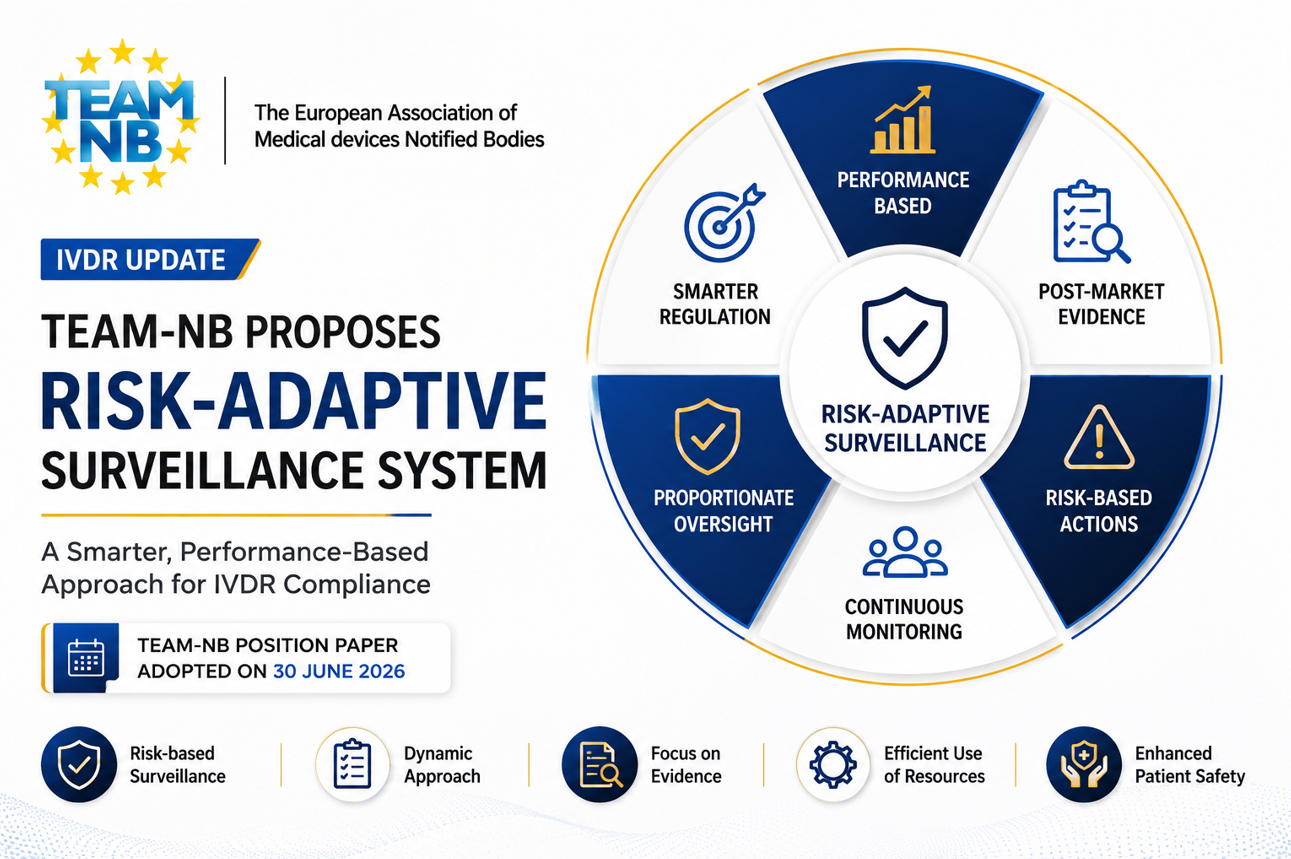
The regulatory landscape for in vitro diagnostic medical devices (IVDs) in Europe continues to evolve as stakeholders work towards making the IVDR more practical, sustainable, and efficient. One of the latest developments is the publication of Team-NB’s Position Paper, adopted on 30 June 2026, which proposes a risk adaptive surveillance system for manufacturers certified under the IVDR. The proposal has been developed as a complementary recommendation to the European Commission’s draft amendment on the future surveillance framework and offers an alternative approach to how Notified Bodies could oversee certified manufacturers throughout the lifecycle of their devices.
Although this is not a legislative amendment and does not introduce any immediate regulatory obligations, it is an important document that reflects how Notified Bodies believe surveillance should evolve in the coming years. More importantly, it signals a broader shift in regulatory thinking—from a process driven primarily by fixed schedules towards one based on actual compliance performance and real-world evidence.
Why Was This Proposal Needed?
Since the IVDR became fully applicable, both manufacturers and Notified Bodies have experienced significant challenges.
Certification under the IVDR demands extensive technical documentation, comprehensive performance evaluation, robust quality management systems, and continuous post-market surveillance. Once certification is achieved, manufacturers continue to undergo regular surveillance audits, technical documentation assessments, and, where applicable, unannounced audits.
At the same time, Europe continues to face capacity constraints among designated Notified Bodies. As the number of certified devices increases over the coming years, maintaining the same surveillance intensity for every manufacturer may not always represent the most efficient use of regulatory resources.
Recognising these challenges, the European Commission has already proposed replacing fixed certificate validity periods with a system of periodic reviews. Team-NB’s position paper builds upon that proposal by introducing a structured framework that enables surveillance activities to be adjusted according to the level of risk presented by both the manufacturer and its devices.
The principle is straightforward. Manufacturers that consistently demonstrate effective quality management, strong post-market performance and regulatory compliance may not require the same level of oversight as organisations experiencing repeated quality issues or safety concerns.
From Fixed Surveillance to Performance Based Oversight
One of the most significant aspects of the proposal is its philosophy.
Historically, surveillance has largely followed predetermined regulatory requirements. Every manufacturer is expected to undergo surveillance activities at defined intervals, irrespective of whether the organisation has maintained an excellent compliance record or has experienced recurring regulatory problems.
The proposed framework moves away from this “one-size-fits-all” approach.
Instead, surveillance intensity would become dynamic, allowing Notified Bodies to increase or reduce regulatory oversight based on objective evidence gathered throughout the lifecycle of the device.
This represents a shift from time based surveillance to performance-based surveillance.
Rather than asking, “Has another year passed?“, the more relevant question becomes:
“What has the manufacturer demonstrated since the last assessment?”
That change in perspective is perhaps the most important feature of the proposal.
What is Risk-Adaptive Surveillance?
Risk adaptive surveillance is exactly what the name suggests.
Instead of applying identical surveillance activities to every manufacturer, the proposal allows Notified Bodies to tailor surveillance according to the level of regulatory risk demonstrated over time.
Immediately after conformity assessment, manufacturers would enter an Initial/Enhanced Surveillance level.
As compliance is demonstrated over several years, surveillance could gradually become less intensive.
However, if significant quality issues emerge, surveillance could immediately be escalated without waiting for the next scheduled review.
The proposal therefore creates a surveillance model that continuously adapts to the manufacturer’s actual performance rather than relying solely on predefined audit schedules.
Three Levels of Surveillance
The proposal introduces three distinct surveillance levels.
- Initial / Enhanced Surveillance
This would apply following completion of the conformity assessment process.
It represents the highest level of regulatory oversight and reflects the limited post-market evidence available immediately after certification.
During this phase, Notified Bodies would closely monitor the manufacturer’s quality management system, technical documentation, post-market activities and regulatory compliance.
2. Medium Surveillance
Where no significant regulatory concerns have been identified over the previous three years, the manufacturer may move to a medium level of surveillance.
This does not reduce regulatory expectations.
Instead, it allows surveillance activities to become more proportionate while continuing to verify ongoing compliance.
3. Reduced Surveillance
Manufacturers demonstrating sustained compliance over approximately six years, without significant safety concerns or major nonconformities, could qualify for reduced surveillance.
Importantly, reduced surveillance does not mean reduced responsibility.
Manufacturers remain fully accountable for maintaining compliance with all applicable IVDR requirements throughout the lifecycle of their devices.
What Could Trigger Increased Surveillance?
One of the strengths of the proposal is that it clearly identifies the types of events that should prompt closer regulatory oversight.
These include:
- Serious incidents involving the device
- Field Safety Corrective Actions (FSCAs)
- Major or repeated nonconformities identified during audits
- Failure to implement effective CAPAs
- Weaknesses within the Quality Management System
- Negative trends identified through Post-Market Surveillance
- Delayed regulatory reporting
- Poor responses to Notified Body requests
- Credible information received from healthcare professionals, competent authorities or other third parties
- Any other evidence suggesting that the manufacturer has lost effective control over its quality or regulatory processes.
This list demonstrates that surveillance decisions would no longer depend solely on scheduled audits. Instead, they would increasingly rely on how effectively manufacturers manage compliance in everyday practice.
The Growing Importance of Post Market Surveillance
Perhaps the clearest message throughout the proposal is the increasing importance of post-market activities.
Certification is no longer viewed as the end of the regulatory journey.
Instead, manufacturers are expected to continuously collect, analyse and act upon information generated after their devices reach the market.
The proposal repeatedly highlights the role of:
- Post-Market Surveillance (PMS)
- Periodic Safety Update Reports (PSURs)
- Vigilance reporting
- Trend analysis
- Corrective and Preventive Actions (CAPA)
- Quality Management System effectiveness
Collectively, these activities provide evidence of whether a manufacturer continues to maintain control over its products and processes.
For many organisations, this represents a cultural shift.
Regulatory compliance is becoming increasingly dependent on demonstrating continuous performance rather than preparing documentation solely for certification.
What Changes Could Manufacturers Expect?
If the proposal is eventually reflected in future legislation, several surveillance activities could become more flexible.
Surveillance Audits
Annual surveillance audits are expected to remain part of the regulatory framework.
However, the depth, scope and overall approach may vary according to the assigned surveillance level.
Manufacturers with a strong compliance record may experience a more focused and proportionate audit programme, while organisations with recurring quality issues may undergo more extensive reviews.
Unannounced Audits
Unannounced audits would continue to play an important role.
The proposal allows their frequency to be adjusted according to surveillance level while preserving the Notified Body’s ability to perform additional “for-cause” audits whenever emerging risks justify immediate intervention.
Technical Documentation Reviews
The proposal also recommends adapting technical documentation sampling during surveillance.
Rather than repeatedly reviewing documentation using a fixed methodology, Notified Bodies would apply a more risk-based sampling approach, concentrating their efforts where regulatory risk is greatest.
For manufacturers with stable product portfolios and a strong compliance history, greater attention may instead be directed towards post-market documentation and ongoing product performance.
Changes to Periodic Safety Update Reports
The proposal also includes revisions relating to Periodic Safety Update Reports.
Among the suggested changes are:
- Annual PSUR updates for Class D devices.
- First-year PSUR followed by biennial updates for Class C devices unless significant changes occur.
- Annual reviews where certificates are issued subject to specific conditions.
- Continued review of PSURs by Notified Bodies during surveillance assessments.
These recommendations reinforce the importance of maintaining high-quality post-market evidence throughout the product lifecycle.
Clinical Performance and Equivalence
Another noteworthy aspect of the proposal concerns clinical performance.
Manufacturers intending to rely on equivalence would be expected to provide stronger scientific justification demonstrating that the equivalent device shares comparable design characteristics, intended purpose, analytical performance and clinical characteristics.
Where sufficient evidence cannot be demonstrated, additional analytical or clinical performance studies may be required to support the manufacturer’s claims.
This reflects the broader regulatory trend towards stronger clinical evidence and greater transparency in performance evaluation.
What Should Manufacturers Do Today?
Although the proposal is not yet law, waiting for formal implementation would be a missed opportunity.
Manufacturers should instead use this period to assess whether their current quality and post-market systems are capable of supporting a more evidence-driven surveillance model.
Some practical questions include:
- Is the PMS system generating meaningful and actionable data?
- Are PSURs supported by robust scientific evidence?
- Are CAPAs closed promptly and verified for effectiveness?
- Are audit findings recurring?
- Can the organisation demonstrate sustained compliance over several years?
- Is management review driving continual improvement?
These are not simply audit questions—they are increasingly becoming indicators of organisational maturity.
Our Perspective
From a regulatory standpoint, the proposal is both logical and timely.
Manufacturers with a well-established quality culture, effective risk management processes and strong post-market surveillance should not necessarily receive the same level of routine oversight as organisations with repeated compliance failures.
Equally important, the proposal does not reduce regulatory expectations. Instead, it encourages manufacturers to maintain continuous control over their products and quality systems. The ability of a Notified Body to immediately increase surveillance whenever new concerns arise ensures that patient safety remains the overriding priority.
Whether this proposal is ultimately adopted in its current form or evolves through future legislative discussions, the direction is becoming increasingly clear. Regulatory oversight is moving beyond periodic certification towards continuous demonstration of compliance throughout the product lifecycle.
Manufacturers that strengthen their quality systems today will be better prepared for tomorrow’s regulatory expectations.
Conclusion
Team NB’s proposal for a risk-adaptive surveillance system represents an important contribution to the ongoing discussion on the future implementation of the IVDR. By aligning surveillance activities with actual compliance performance and post-market evidence, the proposal seeks to make regulatory oversight more proportionate while maintaining high standards of patient safety and public health.
Although the proposal has no legal effect at present, it provides valuable insight into how surveillance under the IVDR may evolve in the years ahead. Manufacturers should monitor future developments closely and continue investing in strong quality management systems, effective post-market surveillance, and timely regulatory compliance not only to meet today’s requirements, but also to prepare for tomorrow’s expectations.
About MedOrdyn Solutions
MedOrdyn Solutions supports medical device and IVD manufacturers with regulatory affairs, quality management, and global market access. Our expertise includes EU MDR, IVDR, ISO 13485, technical documentation, performance evaluation, post-market surveillance, and regulatory strategy.
For support with your IVDR compliance or regulatory requirements, feel free to contact us.
📧 Email: info@medordyn.com
🌐 Website: www.medordyn.com