
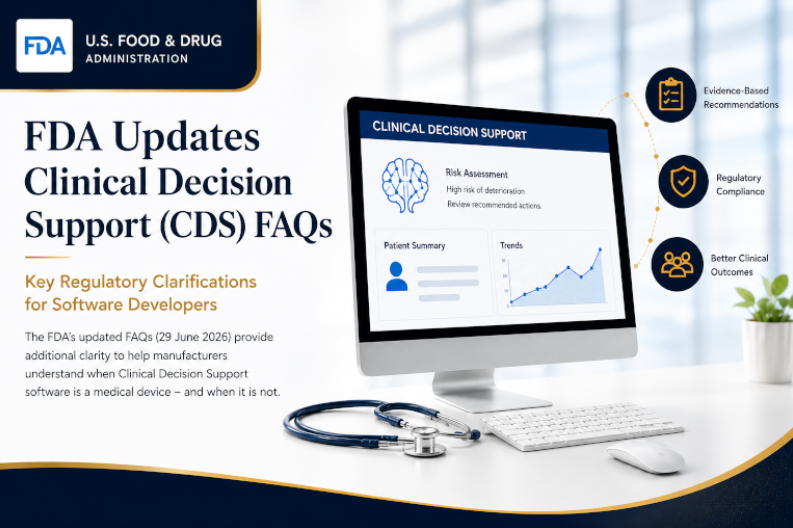
The U.S. Food and Drug Administration (FDA) has updated its Clinical Decision Support (CDS) Software Frequently Asked Questions (FAQs), with the revised document published on 29 June 2026. While the update does not introduce new regulatory requirements or replace the existing Clinical Decision Support Software Guidance, it provides useful clarification on several questions that continue to arise as digital health technologies evolve.
Clinical Decision Support software now plays a role in almost every area of healthcare from clinical documentation and risk scoring to AI-assisted diagnosis and patient monitoring. As these technologies become more sophisticated, distinguishing between software that falls outside FDA regulation and software that meets the definition of a medical device has become increasingly important.
The latest FAQs provide additional insight into how the FDA interprets existing policy and, more importantly, how manufacturers should evaluate software functions during product development.
Digitizing a Clinical Process Does Not Automatically Make It a Medical Device
One of the recurring questions among software developers is whether converting an existing clinical process into software automatically creates a regulated medical device.
The FDA makes it clear that this is not the case.
Software that simply replaces paper-based documentation or digitizes well-established clinical questionnaires generally remains outside medical device regulation, provided it does not analyse patient data or generate recommendations intended to influence diagnosis or treatment. Examples include electronic versions of commonly used surveys, patient-reported outcome questionnaires, or applications that organise and display health information without interpreting it.
This distinction is particularly relevant for companies developing healthcare workflow solutions. Many products are designed to improve efficiency, reduce paperwork or centralise patient information rather than support clinical decision-making. Simply being used in a healthcare environment does not make software a medical device.
From a regulatory perspective, manufacturers should carefully evaluate the actual purpose of the software rather than focusing solely on where it is used or who uses it.
Routine Clinical Calculations Continue to be Viewed as Lower-Risk Functions
The FDA also revisits software that performs simple clinical calculations routinely used by healthcare professionals.
Examples include Body Mass Index (BMI), Glasgow Coma Scale, APGAR Score, Mean Arterial Pressure, NIH Stroke Scale and similar well-established calculations. These calculations have been used in clinical practice for many years and can be independently verified by healthcare professionals without relying solely on the software.
The Agency explains that many of these functions continue to fall within its enforcement discretion policy, meaning they may technically meet the definition of a medical device but are generally considered low risk and are not currently the focus of active FDA oversight.
This clarification is useful because many digital health products incorporate these calculations alongside other software functions. Developers should avoid assuming that every automated calculation automatically triggers a regulatory submission.
Instead, attention should be given to whether the software simply performs an existing calculation or whether it goes a step further by interpreting results, prioritising patients or recommending specific clinical actions.
That distinction can significantly influence the applicable regulatory pathway.
Time Critical Clinical Decision Support Deserves Particular Attention
Perhaps the most significant clarification in the updated FAQs relates to software intended for time-sensitive clinical situations.
Developers often assume that software used in emergency departments or intensive care units automatically becomes a regulated medical device. The FDA explains that this is not necessarily true.
The determining factor is not the clinical setting but the role the software plays in clinical decision-making.
Where software provides recommendations that require immediate action—particularly where life-threatening conditions are involved—it becomes increasingly difficult to demonstrate that healthcare professionals can independently understand and evaluate the basis of the recommendation before acting. In those situations, the software is generally less likely to qualify for the Non-Device Clinical Decision Support exclusion.
However, the FDA also provides an important balance.
Software that simply retrieves and displays recent laboratory results, medication history or other patient information to improve workflow in an emergency department may still remain outside medical device regulation because it is supporting information access rather than directing clinical care.
For manufacturers developing AI-enabled triage systems, patient deterioration monitoring, clinical alerting software or emergency care applications, this distinction is particularly important. Regulatory classification should be based on how the software influences clinical decisions rather than the department in which it is deployed.
Failing One Non-Device CDS Criterion Does Not Automatically Mean FDA Clearance Is Required
Another valuable clarification addresses a misunderstanding that has existed since publication of the Clinical Decision Support Guidance.
Some manufacturers assume that if their software does not satisfy one of the four Non-Device CDS criteria, it automatically becomes a regulated medical device requiring FDA clearance.
The FDA makes it clear that this is not the intended interpretation.
Instead, manufacturers should evaluate the software against the broader FDA digital health framework, including guidance relating to Device Software Functions, Mobile Medical Applications and Enforcement Discretion policies.
In other words, the Clinical Decision Support Guidance should not be used in isolation.
This reinforces the importance of performing a structured regulatory assessment early in product development. Looking at a single guidance document without considering the wider regulatory landscape can easily result in unnecessary submissions or, conversely, missed regulatory obligations.
Products with Multiple Software Functions Should Be Assessed Function by Function
Modern digital health platforms rarely perform a single task.
Many products combine administrative tools, patient engagement features, AI algorithms, decision support modules, reporting dashboards and communication functions within one software application.
The updated FAQs reinforce that the FDA evaluates individual software functions rather than treating the entire platform as one regulated product.
This means that one function may fall outside FDA oversight, another may be subject to enforcement discretion, while another may require full medical device compliance.
For manufacturers, this has important implications during software architecture planning.
Clearly defining intended use, separating software functions and maintaining appropriate documentation for each function can simplify future regulatory submissions and reduce uncertainty during FDA review.
This function-by-function approach has become increasingly relevant as digital health platforms continue expanding beyond traditional Software as a Medical Device.
Clarification for Platform Providers and Software-as-a-Service Companies
The FDA also addresses an area that frequently causes confusion for cloud platform providers and Software-as-a-Service companies.
Providing hosting infrastructure, software development tools or cloud services does not automatically make an organisation a medical device manufacturer.
Responsibility generally remains with the developer that creates and offers the regulated medical software function.
However, organisations providing Software as a Service should remember that offering access to regulated medical software through an online platform does not remove their regulatory responsibilities.
As cloud-based healthcare solutions continue to grow, understanding this distinction is becoming increasingly important for both software developers and technology partners.
FDA Highlights the Relationship Between AI, Predictive Decision Support and ONC Requirements
Artificial intelligence continues to reshape clinical decision support, and the FDA has acknowledged this by addressing Predictive Decision Support Interventions introduced under the Office of the National Coordinator’s HTI-1 Final Rule.
The Agency explains that some predictive algorithms may meet the definition of a medical device, while others may not. Compliance with ONC requirements should therefore not be interpreted as satisfying FDA medical device requirements.
For organisations developing AI-enabled healthcare software, regulatory strategy should consider both frameworks from the earliest stages of development.
As AI models become more complex and increasingly influence clinical decision-making, transparency, intended use, risk management and human oversight will continue to play an important role in determining the applicable regulatory pathway.
Final Thoughts
The updated FAQs do not represent a shift in FDA policy. Instead, they provide practical clarification on questions that manufacturers regularly encounter while developing Clinical Decision Support software.
Perhaps the biggest message throughout the document is that software should always be assessed based on its intended function, the role it plays in clinical decision-making and the extent to which healthcare professionals can independently understand the information presented.
For developers, investing time in regulatory strategy during the early stages of software design is often far more effective than trying to resolve classification questions later in development. As digital health solutions continue to incorporate artificial intelligence, predictive analytics and increasingly sophisticated clinical support functions, these regulatory distinctions will become even more important.
How MedOrdyn Solutions Can Help
Developing Clinical Decision Support (CDS) software, Artificial Intelligence (AI)-enabled medical software, and Software as a Medical Device (SaMD) requires careful consideration of regulatory requirements throughout the product lifecycle. Establishing the right regulatory strategy early can help reduce development risks, avoid unnecessary delays, and support a smoother path to commercialization.
At MedOrdyn Solutions, we partner with medical device and digital health companies to provide end-to-end regulatory and quality support, including:
- FDA regulatory strategy and pathway assessment
- Software as a Medical Device (SaMD) classification
- Clinical Decision Support (CDS) regulatory assessment
- IEC 62304 software lifecycle compliance
- ISO 14971 risk management
- Clinical Evaluation and Clinical Validation
- Cybersecurity documentation
- Quality Management System (ISO 13485)
- Global regulatory submissions and market access
Whether you are developing a standalone CDS application, an AI-enabled healthcare solution, or a Software as a Medical Device, our team can support you from concept through commercialization with practical, risk-based regulatory guidance.
Contact Us
📧 Email: info@medordyn.com
🌐 Website: www.medordyn.com
Reference
U.S. Food and Drug Administration (FDA) – Clinical Decision Support Software Frequently Asked Questions (FAQs) (Updated: 29 June 2026)