
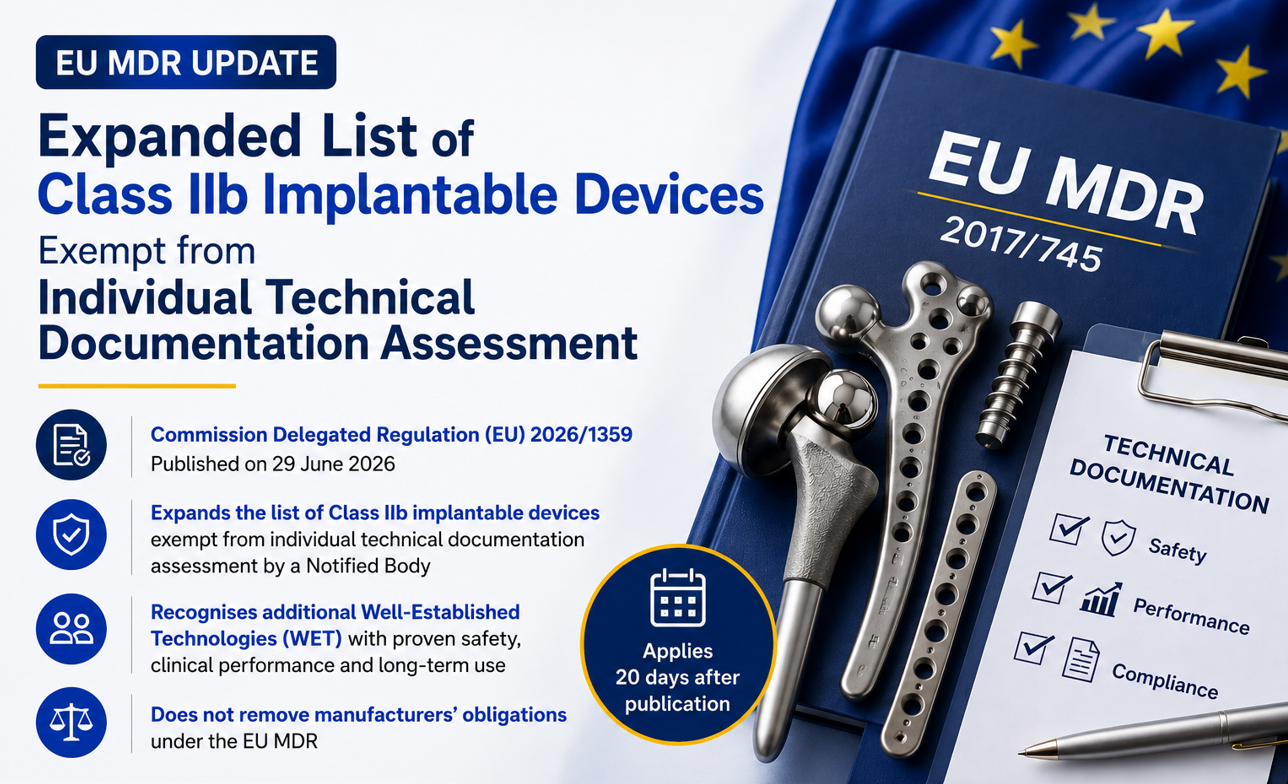
The European Commission has published Commission Delegated Regulation (EU) 2026/1359, introducing an important amendment to Regulation (EU) 2017/745 (EU MDR) concerning the conformity assessment of certain Class IIb implantable medical devices.
Published in the Official Journal of the European Union on 29 June 2026, the Regulation expands the list of Class IIb implantable devices that are exempt from the requirement for a Notified Body to perform an assessment of the technical documentation for every individual device. The amendment will become applicable 20 days after publication.
Although this is not a fundamental change to the EU MDR, it is a practical one. It reflects the regulatory experience gained since the MDR became applicable and recognises that some mature technologies no longer require the same level of scrutiny during conformity assessment as newer or more complex devices.
For manufacturers of eligible Class IIb implantable devices, the amendment may simplify certain aspects of the certification process. However, it does not reduce the manufacturer’s responsibility to demonstrate compliance with the MDR.
Why was this amendment introduced?
Under Article 52 of the EU MDR, Class IIb implantable devices are generally subject to a conformity assessment by a Notified Body. As part of this process, the Notified Body is normally required to review the technical documentation for every individual device within the scope of certification.
When the MDR was introduced, a limited number of Class IIb implantable devices were already exempt from this additional assessment requirement because they were recognised as mature technologies with well-established clinical use.
Following several years of MDR implementation, the European Commission reviewed whether additional device types shared the same characteristics. Working together with experts from the Medical Device Coordination Group (MDCG), the Commission concluded that several additional Class IIb implantable devices also qualify as Well-Established Technologies.
These devices generally demonstrate:
- Common, simple and stable designs
- Well-established safety profiles
- Predictable clinical performance
- Minimal technological evolution
- Long-term clinical use within the European Union
Based on these characteristics, the exemption list has now been expanded.
What has changed?
Commission Delegated Regulation (EU) 2026/1359 replaces the second subparagraph of Article 52(4) of the EU MDR with an expanded list of Class IIb implantable devices eligible for exemption.
The revised list now includes devices such as:
- Cannulas
- Catheters
- Feeding tubes
- Suture pledgets
- Suture sleeves
- Suture buttons
- Gastrostomy buttons
- Bone wax
- Bone fillers
- Bone substitutes
- Stem centralisers
- Diaphyseal obturators
- Radiography markers
- Fiber ligatures
- Transpalatal distractors
- Orthopaedic nails
- Anchors
- Spinal posterior fixation systems
- Textile braids
- Dental implants
- Orthodontic devices
- Dental barriers
- Suspensory fixation devices and cinches
These devices are now recognised as Well-Established Technologies for the purpose of Article 52 of the MDR.
What does this exemption actually mean?
This amendment is often misunderstood.
The Regulation does not exempt manufacturers from EU MDR conformity assessment, nor does it reduce the requirement to maintain comprehensive technical documentation.
Instead, it removes the requirement for the Notified Body to assess the technical documentation for every individual Class IIb implantable device included in the revised exemption list.
Manufacturers must still:
- Maintain complete technical documentation in accordance with the EU MDR.
- Demonstrate compliance with the applicable General Safety and Performance Requirements (GSPRs).
- Operate an effective Quality Management System (QMS).
- Maintain clinical evaluation and post-market surveillance documentation.
- Comply with all other applicable conformity assessment requirements.
In other words, the amendment changes the extent of the Notified Body’s technical documentation assessment for eligible devices; it does not reduce the manufacturer’s regulatory responsibilities.
Practical implications for manufacturers
For manufacturers of eligible Class IIb implantable devices, this amendment may simplify the conformity assessment process by reducing the scope of individual technical documentation reviews performed by the Notified Body.
This may lead to:
- More efficient conformity assessment activities.
- Reduced administrative burden.
- Improved use of Notified Body resources.
- Greater predictability during certification.
However, manufacturers should not assume that inclusion in the revised list automatically simplifies certification.
Technical documentation must still demonstrate compliance with the EU MDR and should continue to include robust evidence relating to design, risk management, clinical evaluation, usability, biological safety, performance testing, and post-market surveillance.
Actions manufacturers should consider
Manufacturers with Class IIb implantable devices should consider the following actions:
- Confirm whether their devices are included within the amended Article 52(4).
- Review their current conformity assessment strategy.
- Verify that technical documentation remains complete and up to date.
- Discuss the applicability of the exemption with their Notified Body.
- Continue maintaining strong quality management, risk management and post-market surveillance processes.
Conclusion
Commission Delegated Regulation (EU) 2026/1359 represents another step towards a more proportionate implementation of the EU Medical Devices Regulation.
By expanding the list of eligible Class IIb implantable Well-Established Technologies, the European Commission has acknowledged that certain mature technologies do not require the same level of individual technical documentation assessment during conformity assessment.
At the same time, the fundamental principles of the MDR remain unchanged. Manufacturers continue to be responsible for demonstrating compliance with the General Safety and Performance Requirements, maintaining robust technical documentation, and ensuring the continued safety and performance of their devices throughout the product lifecycle.
Manufacturers should review the revised exemption list and determine whether the amendment can be incorporated into their EU MDR regulatory strategy.
How MedOrdyn Can Help
Keeping up with changes to the EU MDR can be challenging, particularly when regulatory updates affect conformity assessment requirements.
At MedOrdyn, we support medical device manufacturers with:
- EU MDR regulatory strategy and compliance support
- Technical documentation preparation and review
- Clinical Evaluation Report (CER) preparation and review
- Risk management documentation (ISO 14971)
- Post-Market Surveillance (PMS) and PMCF support
- EU MDR gap assessment and remediation
- Regulatory support for Notified Body submissions and interactions
If you would like to understand how Commission Delegated Regulation (EU) 2026/1359 may affect your devices or your EU MDR compliance strategy, feel free to contact us.
📧 info@medordyn.com
References
- Commission Delegated Regulation (EU) 2026/1359 of 20 March 2026 amending Regulation (EU) 2017/745 as regards the list of Class IIb implantable devices exempted from the obligation to perform an assessment of the technical documentation for every device.
- Official Journal of the European Union, L Series, published on 29 June 2026.